Your business is eating your entire life, and you’re calling it success.
You started this venture to build something meaningful, maybe even to gain more freedom. Instead, you’re answering emails at midnight, skipping family dinners, and feeling guilty about everything. The boundaries between work and personal time blur, and gradually you don’t notice until you are drowning.
Most small business owners treat work-life balance like a luxury they’ll earn after hitting some magical milestone. But, without intentional systems and boundaries, that milestone never comes – never. Growth doesn’t fix burnout. It amplifies it.
Here’s how to build a Work-Life Balance as a Small Business Owner that fuels your life instead of consuming it.
Topics Discussed
Key Takeaways
- Successful entrepreneurs prioritize managing work-life balance by setting clear boundaries between work and personal time.
- Implement systems that promote sustainability, such as time blocking, to focus on high-value tasks and reduce burnout.
- Delegation helps optimize time; outsource low-value tasks to free up energy for strategic work only you can do.
- Create effective self-care practices, including regular exercise and adequate sleep, to maintain mental and physical health.
- Plan breaks and vacations strategically to ensure your business runs smoothly even in your absence.
Understanding Work-Life Balance
Work-life balance for entrepreneurs isn’t about equal hours. It’s about consciously allocating energy to protect what matters most while building something sustainable for you and your family.
What Work-Life Balance Actually Means for Business Owners
Most entrepreneurs chase a 50/50 split between work and personal time, then feel like failures when they realize it is impossible. That’s the wrong framework. Balance isn’t about hours logged. It’s about making conscious choices with your energy and attention across all areas of life without defaulting to business every single time.
Quick reality check: Your business will always have one more task, one more opportunity, one more fire to put out. The work never ends. Balance happens when you decide what gets your best energy and what gets what’s left, and then protect those decisions with systems rather than willpower.
Traditional employees have built-in boundaries. Their work ends when they leave the office. As a business owner and solopreneur, you don’t have that luxury, so you need to build those boundaries yourself with more discipline than someone who clocks in and out.
Need to improve your business’s processes? Check out my Small Business Process Improvement services.
The difference between sustainable and unsustainable business ownership:
Sustainable means scheduling deep work blocks, protecting personal commitments, and building systems that run without you micromanaging every detail.
Unsustainable means you react to every notification immediately, cancel personal plans when business needs arise, and believe being available 24/7 proves your dedication.
When you operate unsustainably, you’re not building a business. You’re building a job with worse hours and no paid time off. That is not healthy for you, your business, and even your family.
Strategies for Successful Time Management
Time management for entrepreneurs isn’t about cramming more tasks into your day. It’s about protecting your highest-value activities and eliminating everything that doesn’t move the needle.
Time Blocking That Actually Works
Calendar blocking fails for most business owners because they treat their calendars as suggestions rather than commitments. Block time for deep work the same way you’d block time for a high-value client meeting, then protect it with the same intensity. Time blocking is one of my favorite things to do. But I don’t do it too rigidly; that’s not the purpose. If I schedule an hour to do something and it takes an hour and 15 minutes, I’m OK with that as long as I can get it done.
Time Blocking Tips To Keep You Focused in Your Business
Time-blocking your day works well for small business owners and solopreneurs, and it helps you see what you have accomplished throughout the day. It also stops you from getting lost in non-urgent tasks.
The most effective time blocking system has three types of blocks:
Deep work blocks: Two to four-hour chunks for your highest-leverage activities. No meetings, no notifications, no exceptions. This is where you build the actual business.
Administrative blocks: Allocate one to two hours. Batched time for email, quick calls, and operational tasks. These don’t require peak mental energy, so schedule them during your natural low-energy windows.
Buffer blocks: Allocate 15-30 minutes. Empty space between commitments that absorbs unexpected issues without derailing your entire day. Most entrepreneurs underestimate how much buffer time they need.
Time blocking only works when you’re brutal about what doesn’t make the calendar. If your calendar is full but you’re not making progress on critical business objectives, you’re blocking time for the wrong activities.
The biggest mistake is blocking every hour of every day. That’s not a schedule. That’s a fantasy that falls apart the moment real life happens. Leave 25% of your week unscheduled to handle the inevitable chaos.
How To Improve Estimating Time on Tasks in Your Business
Did you know it was Time Management Month? It is observed annually in February. It is a great time to improve task estimation in your business.

Delegation and Outsourcing Critical Tasks
You’re not delegating because you think you can’t afford it. The truth is, you can’t afford not to. Every hour you spend on $15/hour tasks is an hour you’re not spending on $500/hour strategy work.
Start by tracking one week of your time in 30-minute increments. Most entrepreneurs are shocked when they see how much time is swallowed up by low-value tasks that someone else could handle better and more cheaply. That tracking data tells you exactly what to delegate first.
Three categories of tasks to delegate immediately:
- Repetitive operational work: Invoicing, data entry, calendar management, and basic customer service inquiries that follow a script.
- Tasks you’re bad at: If you’re spending four hours on something a specialist could do in one hour with better results, delegate it.
- Tasks you hate: The work you procrastinate on consistently drains your energy and rarely gets done well. Get it off your to-do list.

Questions to Ask a Bookkeeper In An Interview
When looking for the right bookkeeper for your small business, there are specific questions you should ask a bookkeeper.
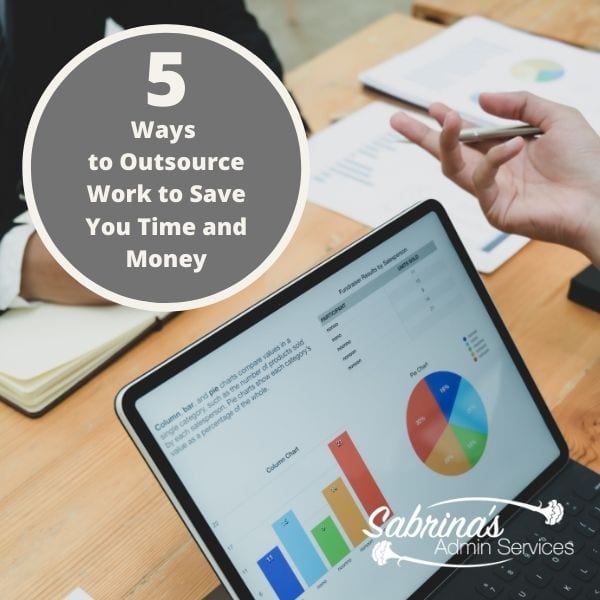
5 Ways to Outsource Work to Save You Time and Money
There are many ways to outsource work for your small business when you feel you are just spending way too much time and money doing it yourself.

How to outsource work at your marketing agency
Marketing agencies are usually the ones companies come to for guidance on what to advertise. These agencies handle a range of tasks, from large, creative, detailed projects to smaller, simpler, less fun ones.
The hesitation usually isn’t about money. It’s about control. You’ve convinced yourself that no one can do it as well as you can, which might be true, but is also irrelevant. Someone can do it well enough, and freeing up your time creates exponentially more value than doing everything yourself.
Start small if you need to: Hire a virtual assistant for five hours a week. Outsource one specific task that’s been sitting on your to-do list for months. See what happens when you actually focus on strategy instead of execution for every single thing.
Most entrepreneurs discover that delegation doesn’t just save time. It improves quality because specialists do their specific work better than a generalist business owner wearing 17 hats.
Building Systems That Work Without You
Your business shouldn’t collapse when you take a day off. If it does, you don’t have a business. You have a high-stress job with extra steps. Systems create the infrastructure that lets your business run whether you’re in the office or on a beach.
Most business owners confuse documentation with systems. Documentation tells someone how to do something. A system ensures it gets done correctly, consistently, without requiring your involvement every time.
As your business grows, it’s important to review and assess what can be automated, what needs to be modified, and what can be easily discarded. I have done this with my small-business clients (affiliate) over the years, and they truly feel like they have their personal lives back. Check out my Process Improvement Services for more information.
Some examples you may want to systemize are:
- Customer onboarding
- Service delivery
- Assemble process
- Communication policies
- Financial operations
The goal isn’t to remove yourself totally. It’s to remove yourself from the repetitive execution so you can focus on strategy, growth, and the high-value client work only you can do.
Take a moment and document the one task you do most frequently. Take a video of yourself doing it, and examine and explain your thought process. Then, hand it to someone else and have them write it out step by step. Reviewing after the steps are written out will help you see gaps and issues, and maybe even realize you can hand the task off to someone else.

How to Create AI Workflow for a Solopreneur Business Fast
You’re drowning in tasks that could run on autopilot. Tasks like email responses, content creation, client follow-ups, calendar scheduling, and social media posting can become daunting and take up most of your time, or go undone because there is no time.
Setting Boundaries to Protect Personal Life
You are not selfish for setting boundaries. I learned this a long time ago when I started my business. I loved helping my clients (affiliate), but I realized I need time for myself too, and can’t let my sanity be sacrificed just for the sake of my clients (affiliate). Below are some ways to set boundaries to protect your personal life.
Have clear work hours.
Set your Google My Business to state your work hours. And if you have clients who do not respect that, send them a link to your Google My Business page.
Benefits:
- Priority clarity: When time is limited, you stop wasting it on low-value tasks and focus on what actually moves the business forward.
- Efficiency gains: Work expands to fill available time. Constrain the time, and you’ll find ways to work faster and smarter.
- Mental recovery: Your brain needs downtime to process information and generate creative solutions. Working 16-hour days doesn’t make you productive. It makes you slow and mistake-prone.
Creating Physical and Mental Separation
If you work from home, make it a point to leave your home in the morning and take a walk. We have done this for many years now because both my husband and I work from home. We take a 1-hour walk each day, rain or shine, cold or hot, and we make it a point to get out of the office and into the home.
And at the end of the day, clean up your desk (affiliate). Then, shut down your computer. Establish a routine that helps you disconnect from your work life. I like to organize the papers and planner for the next day’s work. Turn off the laptop and the lights and leave the office.
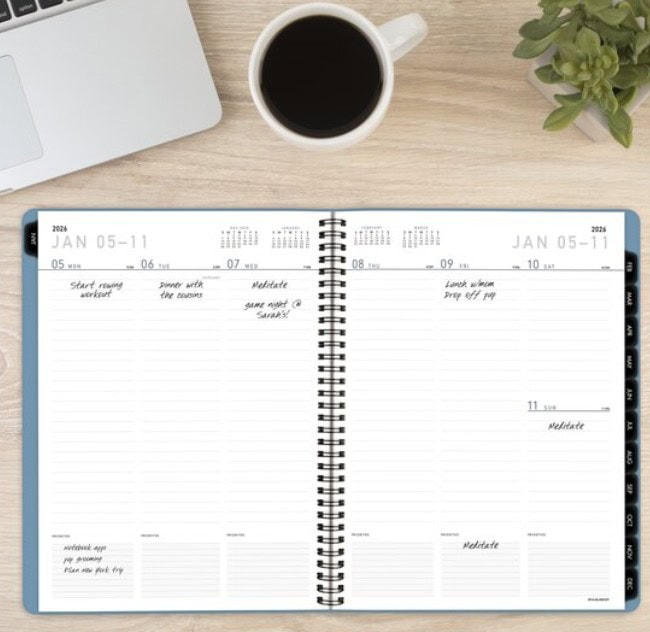
Tired of not knowing what needs to be done this week? A weekly planner is your best form of attack.
Plan to be professional with the AT-A-GLANCE Contemporary Lite Weekly Monthly Planner. Stay ahead of the game all year long with detailed weekly and monthly scheduling pages, presented in a modern style.
Get yours today!

Protecting Family and Personal Time
And you can’t forget to keep those family time and personal commitments. When they are written in the planner, they are written in stone. No going back. Stop what you are doing and keep those commitments at all costs.
Personal time is not flexible time that fits in around work. Personal time is the priority. Work time is flexible. That is why you worked for yourself after all.
Remember, learning to say no is OK too. Remember when you say yes to something, something else is sacrificed. Create priorities that will help you make the decision on what to say yes to and what to say no to.

6 Ways To Reduce Wasted Time in Your Small Business
Imagine this: while working at your desk, you realize you need to go to the filing cabinet in the other room. You have gone there at least 2 to 3 times already today.
Self-Care Practices for Solopreneurs
Lastly, let’s talk about managing work-life balance with self-care practices you can do right now. It’s not about having a face mask or bubble bath; it’s about strategic maintenance that keeps your most important business asset, you, operating at full capacity. Here is a list of physical health practices with the highest return on investment.
- Seven to eight hours of sleep: Protect your sleep schedule the same way you’d protect your most important client meeting.
- Movement every day: It doesn’t have to be intense. A 20-minute walk provides mental clarity and stress relief, saving hours of foggy-headed wheel-spinning.
- Consistent meal timing: Skipping meals and relying on caffeine leads to energy crashes and poor decision-making. Eat at regular intervals with adequate protein.
- Hydration: Dehydration impairs cognitive function before you feel thirsty. Keep water accessible and drink it throughout the day.
It’s important to make this mandatory. You can’t work when you are not at 100%.
Planners for Solopreneurs
 Buy Now →
  Buy Now →
 (affiliate)
Another area you need self-care with is your mental health. Below are some examples of stress-management practices.
Regular check-ins with yourself: Weekly reflections on your stress levels, energy, and mental state help you catch problems early, rather than waiting until you’re in crisis.
Therapy or coaching: Professional support isn’t for people who are broken. It’s for people who want to perform at their best and process challenges effectively.
Peer relationships: Connection with other entrepreneurs who understand the unique pressures you face reduces isolation and provides perspective.
Mindfulness practices: Meditation, journaling, or other practices that help you observe your thoughts instead of being controlled by them build stress tolerance over time.
Stress isn’t the problem. Unmanaged stress is the problem. You can’t eliminate stress from entrepreneurship, but you can develop the capacity to process it without letting it destroy your health, relationships, or decision-making ability.

Build a Support Team for Your Business
I talked about this recently in a post I wrote about who is on your team. These people do not have to be employees; they can be family members, colleagues (affiliate), or anyone else who supports you and your business. I’m sharing the post below for more information.

How to Build Your Small Business Team as a Solopreneur
As small business owners, especially those of us who work mainly alone with clients or sell products to customers, we often feel like we are doing it all by ourselves.
Take a real break and a vacation
It’s important to take vacations. Even if you have to do extra work the week before you leave, having time to do other things will help you enjoy yourself when you return to your business. I wrote about how to take vacations in these posts below.

4 Small Business Things To Do Before Vacation
Going on vacation is so relaxing and fun, right? However, as a small business owner, you must pack up, leave, and handle tasks that will keep your business going before you go.

7 Easy Tasks To Do Before Going on a Mini Vacation
Warm weather is coming, and we are probably planning for some time away to recharge our batteries. It’s not easy for Small Business Owners to go on vacation, though. We have to do a little planning to make sure our work doesn’t come with us.

6 Reasons You Need To Go On Vacation This Summer
As small business owners, we don’t consider vacation a high priority on the list of things to do. We sometimes think of everything else but vacation. It isn’t good to do this, though. We are only human, and we need to relax and decompress.
How to take time off without business chaos:
- Plan ahead: Schedule vacations months in advance and communicate them to clients and team members early so everyone can prepare.
- Document everything: Before you leave, ensure someone knows how to handle common issues and has access to necessary information.
- Set an out-of-office message: Clearly state when you’ll return and who to contact for urgent matters, then trust that system.
- Delete work apps from your phone: Remove the ability to check in impulsively. If there’s a true emergency, people know how to reach you.
Running your business without burning out is the key to success. It’s about making intentional choices that protect your energy, relationships, and health without sacrificing any of it.
We, small business owners, are creative people, and we can make it happen. We just need to spend a little time planning and figuring out what works and what doesn’t.
FAQs to Manage Work-Life Balance as a Small Business Owner
It’s achievable, but not in the way most people think. Work-life balance isn’t about splitting your hours 50/50 between work and personal time — that’s an unrealistic standard. For small business owners, balance means making intentional choices about where your energy goes, then protecting those choices with systems rather than willpower. Without a deliberate approach, growth won’t fix burnout; it will amplify it.
Create physical and mental rituals that signal the end of the workday. Take a morning walk before starting work, and build a shutdown routine in the evening — organize your desk, review your planner for the next day, then close your laptop and turn off the office lights. These small habits create the psychological separation that a traditional office environment provides naturally
Start with three categories: repetitive operational work (invoicing, data entry, calendar management), tasks you’re not skilled at and a specialist could do faster, and tasks you consistently procrastinate on. Track your time for one week in 30-minute increments to identify where your hours are actually going — most business owners are surprised how much time low-value work consumes.
Time blocking means scheduling your work into three types of chunks: deep work blocks (2–4 hours for high-leverage tasks), admin blocks (1–2 hours for email and routine tasks), and buffer blocks (15–30 minutes between commitments for unexpected issues). Most people fail because they over-schedule every hour, leaving no room for real life. Leave roughly 25% of your week unscheduled to absorb the inevitable chaos.
The highest-return physical habits are consistent sleep (7–8 hours), daily movement (even a 20-minute walk), regular meals with adequate protein, and staying hydrated. On the mental side, weekly self-check-ins, peer relationships with other entrepreneurs, and professional coaching or therapy all help manage the unique stress of running a business before it reaches crisis level.
Challenge for today! Take a moment today to think about tasks that are not working for you and start adjusting them so they are lighter in your business.
Now it is your turn. What is your struggle, and what strategy did you put in place to help you surpass it? Please leave a comment below and join in the conversation.
Related Posts:









When I worked in television, my work life bled into my personal life because I didn’t HAVE a personal life. I worked until I couldn’t work anymore, then I’d sleep and start over. I worked into the evenings (and often got called in the middle of the night) and I went in on the weekends to work so that Monday mornings wouldn’t be overwhelming.
For 25 years now, I’ve had a completely different life. Client sessions are scheduled in the afternoons, only, because that’s when my energy is optimal. As I don’t have kids or a spouse, all of my time is my own, so I can’t say I have work/life balance so much as the client side of my business is “work” while the other areas of my business, like blogging, really feel more like my “life,” as much of a hobby (but serving my business) as studying Italian or researching for travel or reading for pleasure.
I love all of your advice, but especially the importance of blocking time for deep work as separate from admin time and the sanity-saving self-care practices. My friends who are also colleagues have been such a boon during the difficult eras of my business.
It’s still hard for me to let go of things that I know are unfinished, but I do apply ALMOST all of the advice you provide. I am still terrible at delegating, not because I don’t appreciate the value, per se, but because unless it’s something I need done, I’m usually happy enough to muddle through. (I miss college, when I could “delegate” my boyfriend to handle any tech problems, though.) And I still don’t sleep more than 5 hours most nights, but I don’t think I’ve slept more than 6 hours straight in my entire adulthood.
This is great stuff. I’m still waiting to see you public a book!
Thanks, Julie, for stopping by and commenting.
Ahhh. The work/life balance. You gave so many wonderful strategies and areas to consider.
Honestly, one of the reasons I started my business over 30 years ago was to create a business that would let me balance my work and personal life. Being your own boss means you get to create the rules and boundaries.
While it took me some time to figure it out, I am very happy with the balance at this point. One of the things that was instrumental in enabling me to do this was understanding and implementing boundaries. Another thing that helped was to be 100% present with whichever ‘hat’ I was wearing. That way, I can enjoy all aspects of the work (clients, marketing, writing, teaching, etc.) and also enjoy all facets of my personal life (time with family, friends, solo time, etc.)
Out of curiosity, you mentioned the value of delegating and hiring a virtual assistant to handle certain aspects of business. What types of things do you use a virtual assistant for?
Thanks for stopping by and commenting, Linda. I really appreciate it.
As for what virtual assistant I used, It really depends on what I would need. I used to have an assistant who helped me around the house with the children so I could have a few hours to work with clients. I also used them to help me create logos. I wrote a post with lots of virtual assistant tasks.
This fabulous advice, Sabrina. I love all the tips you provided as well as the reasons behind them.
Thanks for stopping by and commenting, Diane. I really appreciate it.
You are so right about there always being more to do as a business owner. When I was in my early days, I heard another organizer talk about the endless “list.” I wondered what he meant, but now I know. There is always something I could be doing to improve my business. That said, I didn’t start the business to feel perpetually guilty.
I admit I do struggle with setting uninterrupted blocks because I’m always interrupted at home LOL. I’ve been known to head to the library when I really need to focus. When I’m home, there are frequent knocks on the door, phone calls, repairmen, etc.
Probably the thing that helps me most is having a rhythm to the week. Certain days I do certain tasks, and this helps me know when to start and more importantly when to be finished.
This is an important topic, even for those who aren’t self employed. I see my children struggling as they are expected to be literally on call what seems like 24/7. The virtual work setting has made this even harder.
I totally understand, Seana. We love what we do and it makes it even harder to step away from that and do the other things we love to do also. Thanks for stopping by and commenting. I really appreciate it.