As small business owners, especially those of us who work mainly alone with clients (affiliate) or sell products to customers, we often feel like we are doing it all by ourselves. We answer emails, send invoices, post on social media, fix tech glitches, and keep the books. So when someone asks, “Who is on your team?” the honest answer feels like, “Well… just me.”
But I am here to tell you that you are not working alone—and you never really were. Whether you pay for someone’s help or simply lean on a friend for a sanity check, you already have a small business team. The trick is recognizing it, naming it, and using it well.
In this post, I’ll walk you through who belongs on your team (paid and unpaid), why it matters for the growth of your business, how to organize your people into mini-teams that match your actual workload, and how to communicate with them so they feel respected and stick around. By the end, you’ll have a clear picture of your support system—and probably a much bigger team than you realized.
Topics
- Why should you know who is on your small business team?
- Who could be on your small business team?
- How to create the best team for your business?
- Tips to work with your team
- Common Mistakes Solopreneurs Make With Their Team
- Ready to Build Your Small Business Team?
- Frequently Asked Questions About Building a Small Business Team
Key Takeaways
- Small business owners often underestimate their support systems, thinking they operate alone.
- Identifying your small business team—both paid and unpaid—can help delegate tasks and improve efficiency.
- Unpaid team members include family, friends, and colleagues (affiliate) who provide support without an invoice.
- Creating mini-teams like Technology, Marketing, and Moral Support helps manage different aspects of the business more effectively.
- Effective communication and regular reviews will strengthen your small business team and keep it aligned with your goals.
Why should you know who is on your small business team?
Small business owners love to do it all themselves. I get it—I’ve been there. But sometimes doing it all isn’t necessary, and honestly, it isn’t even smart. As your business grows, you get the luxury of delegating things you are not good at, don’t enjoy, or that simply eat up too many hours in your week.
When you stop trying to be the salesperson, bookkeeper, web developer, and marketer all in one body, you free up energy to do the work only you can do—serving clients (affiliate) and growing the business.
Some benefits of knowing your specific team are:
- You know where to go when you need something.
- Each person knows their purpose and what to do.
- Peace of mind when needing help with issues.
- As you grow the business, these people will help you move forward faster.
- It lets you stay focused on your tasks because you are confident that others will do them.

Who could be on your small business team?
A small business team can include a much wider range of people than you might think. I’ll list most of them here, including some you may not have considered. Some you pay. Some you don’t. All of them count.
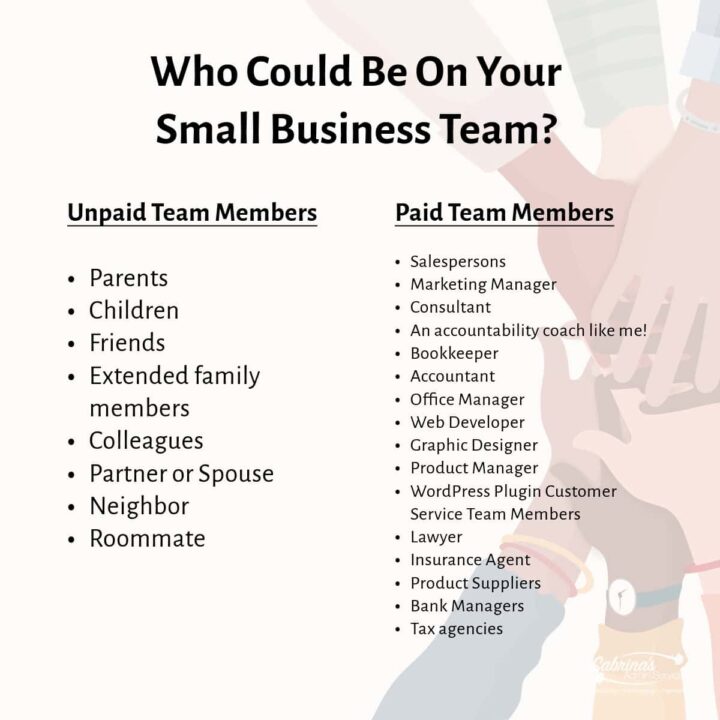
Unpaid team members:
These are the people who help you start, sustain, or grow your business without an invoice attached. They might take on tasks you usually handle, help you hash out solutions when you’re stuck, or spread the word about your business online or in person.
These people could be:
- Parents
- Children
- Friends
- Extended family
- Colleagues (affiliate)
- Partner or Spouse
- Neighbor
- Roommate
Here’s how to tell if someone is really on your team: decide if they consistently help you spread the word or support you. If they show up only once in a blue moon, that’s lovely—but I wouldn’t officially add them. Consistency is what makes someone part of your team.
Paid Team Members:
These are the people who support you in exchange for payment. They might share your vision, or they might simply be specialists you hire for a specific job. Either way, they take work off your plate (affiliate) so you can focus on what only you can do.
Below are the people who may be paid, team members:
- Salespersons
- Marketing Manager – social media manager – online presence manager
- Consultant
- An accountability coach like me!
- Bookkeeper
- Accountant
- Office Manager
- Web Developer
- Graphic Designer
- Product Manager
- WordPress Plugin or software customer service teams
- Lawyer
- Insurance Agent
- Product Suppliers and Vendors
- Bank Managers
- Tax agencies (yes, even the IRS counts as part of your wider business ecosystem)
- Copywriter or content writer
- Business coach or strategist
Don’t overlook software, either. Tools like your scheduling app, email platform, accounting software, and project management system are not people, but they function like quiet team members. They take repetitive work off your plate (affiliate) every single day. Treat them with the same intentionality.
How to create the best team for your business?
Now that you know the team members, you must figure out how to bring these fantastic supporters together to create a successful business. It is essential to group these people according to your specific needs.
Below are mini-teams I recommend creating within your larger small-business team. These can be subdivided further as your business grows.
Technology Team: These are the people you call when your website crashes, your email stops syncing, or your plugin update breaks something. Web developer, IT person, plugin support, and that one tech-savvy friend.
Brainstorming / Logistics Team: These are the people who support you during growth and big decisions. Business coach, mastermind group, mentor, or a trusted colleague who’s been there.
Marketing/Sales Team: . These are the people who help you get in front of your ideal client. Social media manager, copywriter, graphic designer, Pinterest manager, SEO (affiliate) consultant, ad strategist.
Moral Support Team: These are the people who keep you going when business is hard. Family, close friends, accountability partner, mastermind, therapist. Don’t skip this one—burnout is real.
Money Team: These are the people who help you handle the daily, monthly, quarterly, and yearly money tasks. Bookkeeper, accountant, financial advisor, tax preparer, and your banker.
To create a visual version of your small business team, use an app like Microsoft PowerPoint, Canva, or even a simple Google Doc. Build a hierarchy graphic or a simple list that spells out who or which mini-team handles each task. Even if your team members are not employees, this gives you a one-glance answer to “Who do I call?” when something pops up.
I keep mine printed and tucked into my desk (affiliate) drawer. When something breaks or I need quick advice, I don’t waste time scrolling through old emails trying to remember who I used last time.

How to Have an Effective Small Business Meeting
Having an Effective Small Business Meeting is key to a successful business. Meetings should not be long and unproductive. This post shares tips to make them worth having.

How to Have a Small Business Effective Brainstorming Session
Small business owners want their businesses to grow and generate new ideas to make them more streamlined and profitable. Who better to consult than colleagues and employees/staff to determine these ideas? My recent post discussed several effective small-business meeting tips, including brainstorming sessions.
Tips to work with your team
Once your team is built, the real work begins: keeping it strong. Effective communication is what separates a team that powers your business forward from a list of contacts gathering dust.
- Be intentional about how you communicate. Will you reach this person by email, Zoom, Slack, text, or phone? What are their hours of operation? Are there times you should not contact them? Knowing this upfront saves a lot of frustration on both sides.
- Share your goals clearly. Your team can’t support a goal they don’t know about. Whether it’s a quarterly revenue target, a launch date, or a vibe shift for your brand, tell them. A short email or a 15-minute kickoff call is usually enough.
- Stay in touch so they know you’re still using them. When they reach out, reply. When they do good work, say so. The worst thing that can happen is for your team to feel ignored or unappreciated—because that’s when they stop showing up for you. A quick “thank you” goes a long way.
- Review your team once a year. Your business changes—your team should, too. Once a year (I do this in January), look at your list and ask: Is this person still the right fit? Do I need to add someone new? Am I leaning too hard on one person? Adjust accordingly.
- Document what each person does. Keep a simple contact sheet for each team member with their name, role, contact info, and responsibilities. Future you will thank present you the next time something urgent comes up.
Common Mistakes Solopreneurs Make With Their Team
After many years of working with small business owners, I see the same missteps over and over. Here are the ones to watch out for:
- Waiting too long to ask for help. By the time you finally hire a bookkeeper, you’ve already lost months of clean records. Hire earlier than you feel comfortable.
- Hiring only for tasks you hate. Sometimes the best ROI is delegating the task you’re mediocre at but spend the most hours on.
- Forgetting that unpaid team members exist. Your mastermind group, your supportive spouse, your industry friends—these people are doing real work for your business. Acknowledge them.
- Not communicating expectations. Most team breakdowns happen because no one ever said out loud what “done” looks like.
- Doing it alone because hiring feels expensive. The cost of staying stuck is almost always higher than the cost of getting help.
Ready to Build Your Small Business Team?
I hope this post helps you see that you already have more support around you than you realized—and that growing your team on purpose is one of the smartest moves you can make as a small business owner.
If you need help defining your goals, organizing your systems, or getting accountability to actually do the work, please check out my Virtual Consultation Services. I’d love to be part of your team.
Frequently Asked Questions About Building a Small Business Team
Yes—you already have one, even if you don’t call it that. Your accountant, your web host’s support team, your mastermind group, your spouse who listens to you brainstorm at dinner—they’re all on your team. The question isn’t whether you have a team. It’s whether you’re using your team intentionally.
For most solopreneurs, the first paid hire is either a bookkeeper or a virtual assistant. A bookkeeper protects your numbers and your sanity at tax time. A virtual assistant gives you hours back every week by handling email, scheduling, and admin tasks. Pick the one that costs you the most time or stress right now.
Watch for three signals: you’re consistently working past your normal hours, you’re avoiding a task week after week, or you’re turning down work because you don’t have capacity. Any one of those is a sign it’s time to delegate.
Less than you think when you start with unpaid team members (mastermind, mentor, accountability partner) and a few targeted paid roles. A bookkeeper might run $200–$600 a month for a solopreneur. A virtual assistant might be $25–$75 an hour, depending on skill level. Start small and add as your revenue grows.
Keep a simple contact sheet for each person with their name, role, contact info, hours, and responsibilities. Group them by purpose (tech, money, marketing, moral support). Review once a year and adjust as your business grows.
Start with your free team. Join a mastermind. Find an accountability partner. Trade services with another solopreneur. Use the customer support that comes with the software you’re already paying for. You can build a real team without spending another dollar—and that team will help you get to the point where you can hire.
Share this post!
Did this help you rethink who is on your small business team? Pin it to your favorite Pinterest board for solopreneur tips, and share it on LinkedIn or Facebook with a fellow business owner who thinks they’re doing it all alone. They’re not—and now they’ll know it. Feel free to use #SabrinasAdminServices
Related Posts









Delegating is hard. You’re right. It takes practice and patience with others and yourself. As far as my team I had a bookkeeper cleanup and setup my systems 2years ago and have been able to maintain it after that. It’s been nice. I used to be so overwhelmed trying to keep up. ai learned from that experience how valuable it is to let others help you.
This post prompts a great re-think of the way I run my business. When I started, I had (unpaid) friends who served as my advisory board. None had run their own businesses , but they were high enough in the hierarchies where they worked (whereas I’d come from a profession with a fairly flat hierarchy) that they were able to give me valuable perspective. They helped with naming my company, getting my URL, etc. But once my business was on the upswing, I no longer sought help.
I am always inclined to try to go it alone. Part of that is because I’m extremely frugal; I hire only when I absolutely can’t figure something out on my own but desperately can’t function without assistance, even though I know I’m often spending (the value of) more time than it would cost to hire someone.
Yes, I need to work on that. But it’s not just financial reasons that hold me back. I find dealing with most customer service (such as with my domain host and WordPress support team) so frustrating that I would almost always rather Google a solution than try to call. (It’s like dealing with a mechanic; you have to have so much trust that someone else is dealing honestly and is right, and I seem to lack that trust gene!) I do my own bookkeeping and taxes, I haven’t brought my marketing/web design into modernity, and when I pay for services, it tends to be of the corporate variety (Zoom, Dropbox) and not the human kind.
I do seek out my circle of friends for technological questions and have accountability partners and a mastermind group for seeking perspective and emotional support, but because I don’t have children, extended family, partners, roommates, or neighbors, it still “feels” like my options are pay someone or just NOT do what I’d like to have done, and too often I pick the latter option.
This post really offers some great perspective!
Even though I’m a solopreneur, I have a team of people who help. The team has varied depending on the business stage or projects I’m working on.
For example, when I wrote and published my book, I assembled a specific book team, including a book coach, book designer, cover designer, editor, and marketing person. The book team included many others, such as family, friends, and colleagues who read drafts, cheered me on, and helped spread the word.
When I started offering virtual workshops, I enlisted help for brainstorming, planning, and tech support.
I also have an accountant and a web designer/website “fixer.” I’ve also hired accountability partners, marketing experts, and many other people to help.
As Diane says, “It takes a village.”
I love this post. I think most small business owners start out doing it all, but much realize when they’ve reached the point that they need to delegate. When it was my time I thought about what I hated doing or wasn’t good at doing and I found people to take over those tasks.
Also, for years, my Emotional Support team was a mastermind group. We talked about everything business and personal and supported each other at whatever point we were at at the time. The best!
Like Seana, I realized that I have more members on my team than I had thought. I have an accountant, a webmaster, a business coach, a graphics designer, and colleagues who support my efforts.
It does take a village!
It’s funny, since I am a solopreneur, when I read the title I initially thought, “me!”
But then as I read your post, I realized I do have others on my team.
I have an accountant, a website designer, and a graphic designer. I also have volunteers who edit my blog posts and help with investing.
Lastly, I have connections with other businesses who provide complimentary services to my own.
So I guess I have a bigger team than I realized – which is a very nice thought!