When advertising on social media, your website, or traditional media, the phrase “Call to action” is defined as a phrase to help “prompt an immediate action.” Small business owners must create a call to action for every advertising medium they use. We need to remind people of their next steps. So, getting familiar with these terms is essential. I’m sharing 35+ call-to-action (CTA) words. Remember, these call-to-action (CTA) words are only examples of phrases you can use. There are plenty more out there. Here are 35+ tips for using these terms effectively.
Keep in mind that when advertising on social media, using a short phrase repeatedly can come across as spammy and may turn customers off from clicking through or buying your product.
Topics
Key Takeaways
- Call-to-action terms prompt immediate action, helping guide your audience on what to do next.
- Small business owners need strong CTAs in every ad, post, and email to clarify their goals and engage users effectively.
- Using action verbs in CTAs and matching them to the platform boosts engagement and response rates.
- Examples from popular brands show that CTAs can appear anywhere in your content and should feel natural.
- Always personalize your CTAs and keep them short to avoid overwhelming your audience with choices.
Why Call to Action Terms Matter for Small Business Owners
Every post, email, and ad you publish has a job to do — but without a clear CTA, your audience doesn’t know what that job is. A well-crafted call to action removes the guesswork and tells your reader exactly what to do next.
Think of your CTA as the bridge between your content and your business goals. Whether you want someone to book an appointment, download a freebie, or follow your page, the right words make all the difference.
Action tip: Before you write your next social media post, ask yourself: “What do I want someone to DO after reading this?” Then match your CTA to that goal.
Real-World CTA Examples Worth Studying
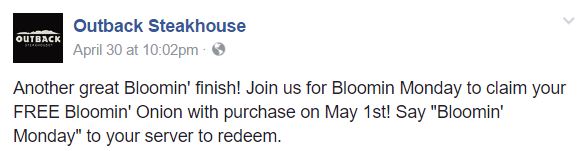
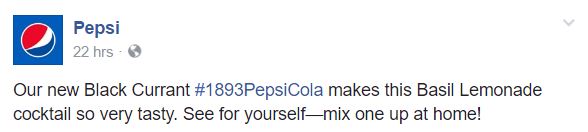
Write up creative ways to incorporate these phrases into your posts. Remember, the CTA doesn’t have to be the last sentence in the post. Check out these posts from Outback Steakhouse, Pepsi, and Bed Bath & Beyond.
As you can see in the Outback social media ad, the call to action is “Join us” and appears in the middle of the post rather than at the end. The end sentence talks about what you need to do to “Join us” as well.
In the Pepsi ad, they even used a custom hashtag alongside the “see for yourself” call to action. This post offers a creative suggestion for making a drink without bluntly saying, “Make this drink.”
When Bed Bath & Beyond was advertising, they had a post that used the phrase “We’ve got you covered.” While subtle, it clearly communicates what they want you to do — click the link and make a purchase.
These posts are just examples of ways you can phrase your call to action, but coming up with fresh wording on the spot isn’t always easy. That’s why having a go-to reference list is so helpful.
Tips for Writing Stronger Call-to-Actions
Before you review the term list below, keep these best practices in mind:
Match your CTA to your platform. What works on Facebook may feel off on LinkedIn. A casual “Grab yours now!” fits Facebook beautifully, while LinkedIn tends to respond better to “Learn more” or “Download the guide.”
Create urgency without being pushy. Phrases like “limited time,” “only a few spots left,” or “this week only” encourage action without feeling like a hard sell. Just be sure the urgency is real. False scarcity damages trust.
Use action verbs. Strong CTAs start with a verb: Download, Join, Save, Start, Get, Book, Register. These words trigger action because they tell people exactly what to do.
Test different CTAs. If you run paid ads, try A/B testing two different CTA phrases to see which one gets more clicks or conversions. Even on organic posts, pay attention to which posts get more engagement when you use different wording.
Keep it short and visible. On social media in particular, your CTA should be easy to spot. One clear ask per post is almost always more effective than multiple competing directions.
Personalize when possible. Swapping “Get your free guide” for “Get your free guide for real estate agents” makes the CTA feel as if it were written specifically for your ideal client.
Action tip: Review your last five social media posts. Did each one have a clear call to action? If not, add one and see if engagement improves.
For more social media guidance, visit 12 Questions To Ask Before Posting On Your Company’s Social Media Page and Social Media Terms Business Startups Need to Know.
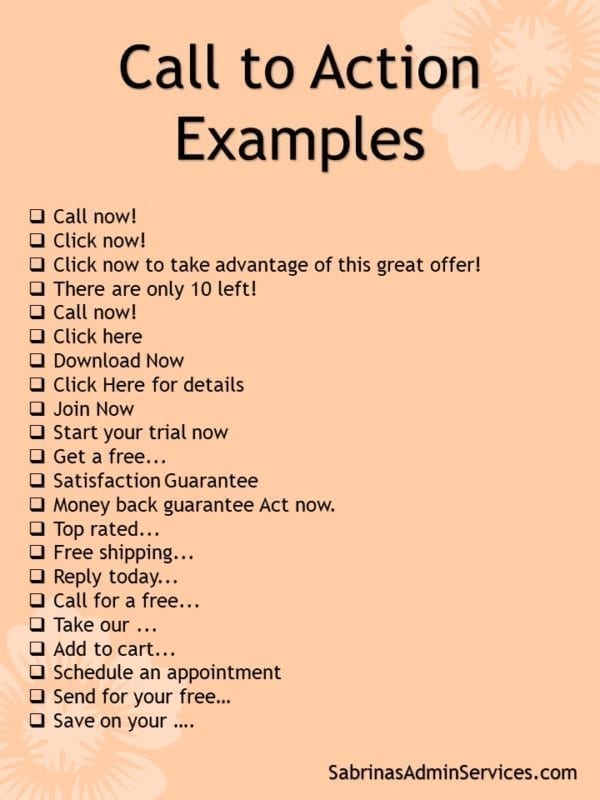
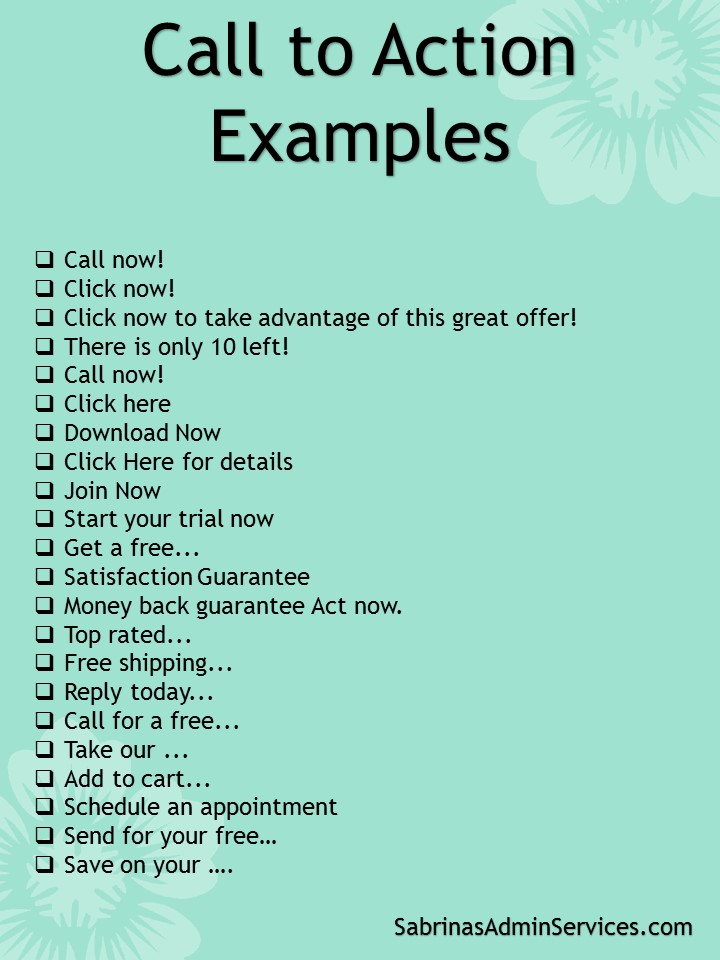
Call to Action Term Examples.
Use this list as a starting point and adapt each phrase to fit your voice and your offer:
Call now!
Click now!
Click now to take advantage of this great offer!
There are only ten left!
Click here
Download Now
Click Here for details
Join Now
Start your trial now
Get a free…
Satisfaction Guarantee
Money-back guarantee: act now.
Top-rated…
Free shipping…
Reply today…
Call for a free…
Take our…
Add to cart…
Schedule an appointment
Send for your free…
Save on your …
More CTA Terms to Add
Here are additional phrases that work especially well for service-based businesses and solopreneurs:
Book your free call today
Reserve your spot
See how it works
Let’s get started
Claim your discount
Try it free
Read the full story
Find out how
Take the next step
Tell me more
Yes, I want in!
Get instant access
Browse our services
Watch now
Follow for more tips
These phrases can be used across all industries.
Action tip: Create a list of your favorite call-to-action terms to remind you what’s available when creating posts and ads. Check off the ones you’ve used recently so you don’t repeat the same phrase too often. Below is a printable to get you started.
Where to Use CTAs Beyond Social Media
Don’t limit your CTAs to social media posts. Here are other places where a strong call to action can make a big impact:
Email newsletters — Every email should end with one clear CTA. Whether it’s “Read the full post,” “Book a consultation,” or “Reply with your question,” give readers one next step.
Your website — Every page on your site should have a purpose. Your homepage, services page, and blog posts should all guide visitors toward an action, such as contacting you, scheduling a call, or downloading a resource. Check out Sabrina’s Admin Services as a reference for incorporating CTAs naturally throughout your service pages.
Pinterest pins — Pin descriptions with a CTA get more click-throughs than those without. Try “Click to save this checklist” or “Visit the blog for the full guide.” For more tips, read How to Use Pinterest Trends to Help Drive Traffic to Your Business.
Blog posts — Always end your blog posts with a CTA, whether it’s inviting comments, pointing to a related post, or encouraging readers to contact you.
Email signatures — A brief CTA in your email signature (“Book a free 15-minute call today!”) puts your offer in front of every person you email.
Frequently Asked Questions About Call to Action Terms
A call to action is a short phrase that prompts your audience to take a specific next step — clicking a link, signing up, downloading something, booking a call, or making a purchase.
Without a CTA, readers often move on without doing anything, even if they liked your content.
As a general rule, one CTA per post is most effective. Multiple asks can confuse readers and reduce the likelihood that they take any action at all. Pick the one action that matters most and make it easy to take.
You can — but you shouldn’t. Using the same phrase repeatedly can start to feel repetitive and even spammy to your audience. Rotate through different terms and keep your wording fresh.
The printable list in this post is a great tool for tracking which phrases you’ve used.
Effective CTAs are clear, specific, and action-oriented. They use strong verbs, speak directly to the reader (“you”), and often include a reason to act now (a deadline, a limited quantity, or a free offer). They also match the platform’s and audience’s tone.
No — each platform has its own culture and audience expectations.
Instagram audiences respond well to CTAs in captions and Stories (“save this post,” “tap the link in bio”).
LinkedIn readers prefer professional language like “learn more” or “connect with me.”
Facebook tends to work well with conversational CTAs.
Pinterest drives traffic best when pin descriptions include a clear reason to click through to a blog or resource.
A CTA tells your audience what action to take. A hashtag helps categorize your content and increase its discoverability. Both can appear in the same post and serve different purposes.
CTAs don’t have to go at the end! As the Outback Steakhouse example shows, a CTA can appear in the middle of a post and be reinforced again at the end. The key is that it feels natural within the flow of your content, not forced or bolted on.
Not at all. CTAs are just as important — maybe more so — in your organic content. Every blog post, social media caption, email, and website page benefits from a clear next step for the reader.
Need Even More CTA Resources?
Here are a few fantastic articles to deepen your knowledge:
11 Kick-Ass Call to Action Examples, and Why They Work — WordStream
How To Write A Call To Action In A Template With 6 Examples — CoSchedule
And from our own blog: How to Sell Without Selling: 25 Phrases That Work on Social Media
There you have it. I hope this helps you get creative with your call-to-action phrases. What is your favorite call to action? I would love to hear from you.
If you need help creating posts for your social media pages, feel free to contact me to get a quote (Sabrina’s Admin Services Social Media Marketing Services). You can do this!
Please note that these are affiliate links through Amazon (affiliate), and at no additional cost to you, I will earn an affiliate fee if you decide to make a purchase.
Related Posts!






I love the examples you found! So much more compelling than “click here” or “check it out!”
Thanks, Janet. It’s important to remember there are creative ways to ask people to take action. Thanks for stopping by and commenting. =)