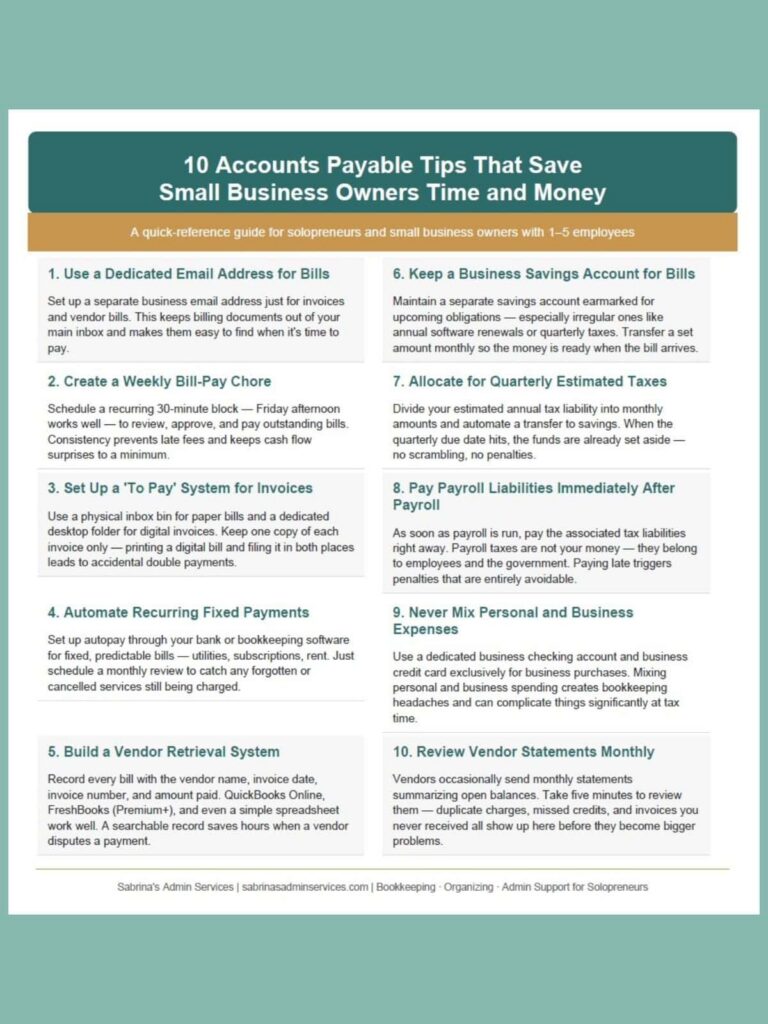
Running a solo business or managing a small team means wearing every hat — including the one nobody wants: tracking down bills, chasing bills, and making sure vendors get paid on time. When accounts payable feels like a chore you keep pushing to tomorrow, late fees creep in, vendor relationships suffer, and your cash flow picture gets murky fast. Guess what, you don’t need a full accounting department to run a clean, stress-free Accounts Payable (AP) process. Whether you’re a solopreneur managing everything yourself or a small business owner with a handful of employees, these practical accounts payable tips will help you build a simple system that actually works — and keeps you from ever scrambling to find a lost bill again. FYI: from here on, I will use AP for Accounts Payable.
Topics
- How do I stay on top of my business accounts payable?
- Common Accounts Payable Mistakes Solopreneurs Make
- Always have a Savings Account to store money for Bills.
- Allocate the money you need for taxes and divide that amount into quarters.
- Always, always, always pay your payroll liability on time.
- Frequently Asked Questions About Accounts Payable for Small Businesses
Key Takeaways
- Managing accounts payable (AP) efficiently helps prevent late fees and improve cash flow for solopreneurs and small businesses.
- Establish a simple system for bill payments, including separate email accounts and organized document storage.
- Automate payment processes with tools like bank autopay, QuickBooks, or Bill.com to save time and reduce manual errors.
- Regularly review AP practices to avoid common mistakes such as mixing personal and business expenses or ignoring vendor statements.
- Always pay payroll liabilities on time to avoid penalties and maintain good vendor relationships.
How do I stay on top of my business accounts payable?
Below, I will share tips for staying on top of your accounts payable system, whether you are a solopreneur or a small-business owner.
Have a Simple System for Paying Your Business Bills.
If you want to go paperless, you can use your bank’s bill pay system, which will send the checks for you.
Use a different business email address for business bills
Use a separate email address for bills. Then, when you create online accounts, use that email address as your contact. This will help eliminate bills getting lost in the vast number of emails you receive daily.
Have a designated spot to store paper bills/electronic bills
For paper bills, have a place to store them, like a “To Pay” bin. This can be a wire bin placed near your desk (affiliate).
For electronic bills: Have a 3-part system in place. If you receive emails with bills attached,
- Print out the bill only once,
- Add it to the “to pay” bin,
- Store the electronic copy under the “bills to pay” folder on your computer.
By doing this, you will have only one copy of the bill and be less likely to overpay the vendor.
Create a weekly billing chore.
Create a regular billing task. It can be once a week or once every few weeks. If you do it weekly, Friday afternoon works nicely. It will keep you on track and minimize the loss of any “To Pay” bills.
Create a long-term store retrieval system.
Enter each bill separately. Add the bill issue date, amount, and number, and then include it in your register. QuickBooks Online allows you to add it to the vendor section on its app. You can also create a spreadsheet to help manage this. Be sure to have a part for the vendor name if you use a spreadsheet. Keeping track of all bills will speed up locating a specific bill if there is a discrepancy with the vendor.
Create a well-organized Petty Cash Tracking System.
If you use cash often, you need a good system to help you and your business eliminate fraud. Only one trusted person should be responsible for it. Have them reconcile it monthly to ensure it matches your spreadsheet’s transactions. Be sure to keep receipts for all activities paid in cash.
A spreadsheet file, such as Microsoft Excel or Google Sheets, works well for this purpose. Be sure to include details on the spreadsheet, such as a date column, a payee column, a category or chart of accounts column, a description of what you purchased, an amount column, and an X column to indicate that you have filed the receipt in the appropriate accordion folder tab. This part will help you keep track of the receipts (supporting paperwork).
If you do not have many receipts, an accordion folder with 13 pockets, one for each category you have, is plenty.
Supplies needed to manage Petty Cash
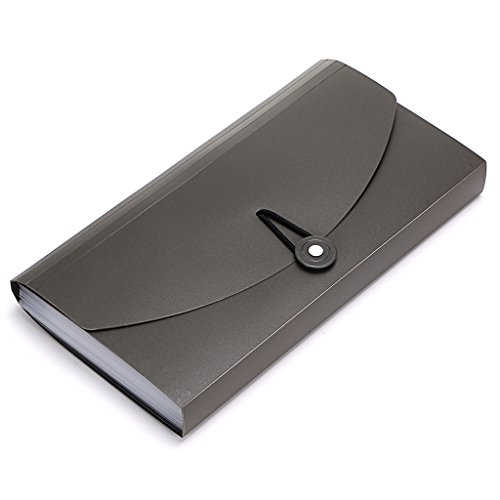
Accordion File Folder Small Holder File 13 pockets
Buy Now →
Label Maker – P-touch CUBE Plus Bluetooth, white uses an APP
Buy Now →(affiliate)
Use Automation Tools to Simplify Bill Payments
One of the biggest time-savers available to solopreneurs and small business owners in 2026 is bill payment automation. You don’t need a full accounting department to take advantage of it; even a one-person operation can set this up in an afternoon.
Here are a few options worth considering:
Bank autopay. Most business checking accounts now offer free autopay scheduling. This works great for fixed, recurring bills like subscriptions, utilities, and rent. Set it once and let it run. Just make sure you review these charges monthly, so you aren’t paying for services you’ve canceled or forgotten about.
QuickBooks Bill Pay. If you’re already using QuickBooks Online to manage your bookkeeping, their built-in bill pay feature lets you schedule and pay vendors directly from inside the software. It keeps your AP and your books in sync automatically, eliminating the need for a separate reconciliation step.
Be sure to check with your bank to confirm they are compatible with QuickBooks Online. If they are not, it can create another issue you don’t want to deal with.
Bill.com or similar AP platforms. For small businesses with even one or two employees handling approvals, a dedicated AP tool like Bill.com adds an extra layer of control. You can route ibills for approval, pay by ACH or check, and store everything digitally in one place.
FreshBooks (affiliate). If you’re already using FreshBooks (affiliate) for client invoicing, their Premium and Select plans include a full accounts payable workflow: vendor records, bill entry, bill payments, bill scanning, and an AP aging report.
The AP feature is available on Premium and Select tiers, where the workflow centers on vendor records, bills, bill payments, bill scanning, and an AP aging report. It’s a natural fit for service-based solopreneurs who want invoicing and AP managed in one place without juggling a separate tool. Just note that AP features aren’t available on lower-tier plans, so check your current subscription level before assuming they’re included.
Quicken (affiliate) Home, Business & Rental Property. If you prefer desktop-based software that handles both your personal and business finances, Quicken’s Home, Business & Rental Property plan is worth a look.
It lets you create a dedicated accounts payable account, enter vendor transactions using built-in bill and payment forms, and schedule recurring bill payments such as monthly rent, utilities, or quarterly tax payments, so Quicken (affiliate) reminds you when each one is due. Bill Pay is included free with this plan, giving you the option to schedule payments to thousands of digital billers or have Quicken (affiliate) mail paper checks to vendors on your behalf. It’s a solid choice for solopreneurs who want everything — personal budget, business bills, and rental tracking in one place.
Receipt and expense capture apps. Tools like Dext(formerly Receipt Bank) or the built-in receipt capture in QuickBooks let you photograph a receipt the moment you get it. No more lost paper receipts stuffed in a bag or car console. The expense is captured instantly and is ready to be categorized.
The goal isn’t to automate everything blindly — it’s to remove the friction from routine payments, so your mental energy goes toward actually running your business.
Below are some popular posts relating to Accounts Payable for a solopreneur or small business. Feel free to check them out.

How to Make a Well-Organized Business Digital Receipt Organizer
Now that almost all businesses do transactions digitally, it’s a great time to organize your digital receipts. This post will provide everything you need to set up a digital receipts organizer, allowing you to access your important documents when tax time rolls around. Learn about why to go paperless and tips on how to start!

How to Keep Business Credit Card Receipts
While reconciling bank accounts is essential, you also need proof of receipt for all your transactions, including credit card transactions. Today, we will discuss the importance of keeping receipts for credit card statements and ways to organize your credit card transactions.
Making A Small Business Subcontractor Tracking Sheet
Creating a Small Business 1099 tracking sheet for your 1099s will make your process easier at the beginning of the year for the prior year. This week, we are sharing how to create this tracking sheet to add to your small business end-of-year tasks.
Common Accounts Payable Mistakes Solopreneurs Make
Even experienced business owners fall into some of these traps. Here’s what to watch for:
Mixing personal and business expenses.
This is one of the most common AP pitfalls for solopreneurs. When personal charges slip onto a business card (affiliate) (or vice versa), it muddies your books and can create headaches at tax time. Keep a dedicated business checking account and business credit card.
Ignoring vendor statements.
Vendors will sometimes send monthly statements summarizing what’s owed. It’s tempting to skip reviewing these, especially if you feel like you’re on top of things. But occasional discrepancies happen; duplicate charges, credits you’re owed, bills you never received. A quick monthly review catches these before they become bigger problems.
Paying from memory instead of a system.
Many small business owners simply remember when bills are due. That works — until it doesn’t. One busy week, one sick day, one distraction, and a payment slip. A simple system (a calendar alert, a “to pay” bin, a weekly AP chore) is always more reliable than memory alone.
Not keeping backup documentation.
Even for small purchases, keep a record. If you’re ever audited or a vendor disputes a payment, you’ll want proof. A digital folder organized by vendor and year takes minutes to set up and can save hours of stress later.
Letting AP pile up.
Some solopreneurs only look at bills when something is overdue. This reactive approach leads to late fees, strained vendor relationships, and cash flow surprises. Proactive, scheduled AP review — even just once a week — keeps you in control.
Always have a Savings Account to store money for Bills.
If you have the money and the time to pay, just pay now.
If you don’t want to schedule a payment for a particular bill, you can always allocate the money for that bill in your bank register for a future date, so it reminds you to pay it when you next open your app. It may sound cumbersome, but it really helps remind you what needs to be paid. Here’s how to do it.
a. Go to your register in your app.
b. Write the payee’s name and amount. But don’t write the check number.
c. Then, when it is time to write the check, just fill in the check number.
Entering the check number will remind you that you wrote the check.
Another way to allocate money is to write the check, prepare the envelope (affiliate), and put a sticky note on it that says “MAIL ON ________ (fill in date).” Then place the envelope (affiliate) in a location that reminds you to mail the bill on that date. I have used this method for payments that I need to bring to a vendor, and it works pretty well. No lost checks.
Visit our How To Create A Small Business Emergency Savings post for more details on how to set up a savings account.
Allocate the money you need for taxes and divide that amount into quarters.
Then, divide the amount into monthly installments. Schedule an automatic transfer to the savings account for that monthly amount each month. It will automatically transfer the money; when it comes time to pay it, you can transfer it back and pay the taxes. Remember, if you don’t pay estimated taxes, you may be penalized by the federal, state, and local governments.
Always, always, always pay your payroll liability on time.
After you have finished your payroll, have your bookkeeper withhold the liability taxes and pay them right away. The tax agencies set deadlines based on how often companies run payroll. But you don’t need to use them; you just need to pay for them on time. It’s OK to pay your payroll liability taxes early. I have done it for years for my payroll clients (affiliate). But you can get penalized for NOT paying your payroll liability taxes on time. Remember: this is not your business’s money. It’s money for your employees and taxes you have collected for the government and others (insurance and retirement).
Running a solo business or managing a small team means wearing every hat — including the one nobody wants: tracking down bills, chasing bills, and making sure vendors get paid on time. Share on XFrequently Asked Questions About Accounts Payable for Small Businesses
Accounts payable (AP) refers to the money your business owes to vendors, suppliers, and service providers for goods or services already received. For solopreneurs and small business owners, staying on top of AP means avoiding late fees, maintaining healthy vendor relationships, and keeping an accurate picture of your cash flow at all times.
Once a week is ideal for most small businesses. A short Friday afternoon session — reviewing what’s due, what’s been paid, and what’s coming up is enough to stay on top of things without it taking over your schedule. If your volume is low, every two weeks can work, but weekly is the sweet spot for avoiding surprises.
Autopay works well for fixed, recurring charges like subscriptions, utilities, loan payments, and rent. For variable bills from vendors or contractors, manual review before payment is smarter. You want to verify the amount and approve it before money goes out the door.
A simple two-folder digital system works for most solopreneurs: one folder labeled “Bills To Pay” and one labeled “Bills Paid – [Year].” Within the paid folder, create subfolders by vendor name. Add the bill date and amount to the file name so you can find anything in seconds. Pair this with a “to pay” physical bin on your desk for any paper bill.
Don’t pay it, and don’t ignore it. Contact the vendor promptly, reference the bill number, and clearly describe the discrepancy. Ask for a corrected bill before processing payment. Keep a written record (email is fine) of the dispute and the resolution. This protects you if the issue comes up again later.
es — and this is non-negotiable from an AP standpoint. A dedicated business checking account keeps your business expenses separate from personal ones, makes tax preparation faster and more accurate, and gives you a clean record if you’re ever audited. Many banks offer free or low-fee business checking options specifically designed for sole proprietors and single-member LLCs.
Contact the vendor right away, reference both payment dates and amounts, and request a refund or credit toward a future bill. Most reputable vendors will correct this quickly. Going forward, mark bill as “PAID” with the date and check/transaction number the moment they’re processed so duplicates don’t happen again.
I hope this inspired you to review your accounts payable system and refine the process.
Feel free to visit more posts on small-business accounts payable.
Accounts Payable and Your Business: What You Need to Know
Do you have any tips you would like to share? What did you find interesting? What would you like to try? Please share in the comments below. I would love to hear from you.
Please note these are affiliate links through Amazon (affiliate), and at no additional cost to you, I will earn affiliate fees if you decide to make a purchase.
Related Posts









I don’t have a savings account for bills, but it’s a great idea especially for income tax. Mostly, I rely on my bookkeeper to take care of my AP and it works well.
Have had the separate email account for bills for some time now and it really is far more efficient. Trouble is I now have another email account to check. This was really a most informative post. It’s always good to know where and how your money is being saved and spent
I love the idea of a separate email account just for bills. I have been known to accidentally delete bills when ploughing through my inbox.
Hi Sabrina,
These are excellent accounts payable tips!! It really is so important to stay organized and current on all of your business account information 🙂
Thanks for sharing this awesome info!! Always a good thing to know and remember 🙂
Very thorough information. I find that paying my bills the same day every week helps to keep things from falling through the cracks. I also prefer paper bills to online. Too easy to miss online, although your idea about a separate email is great.
Great tips. I especially liked the tip about having a unique email address to manage electronic bills. You know your stuff!
Good points Sabrina. I’ve had different systems over the years. I’ve refined it down and enter payment dates into my calendar, so I always stay on top of them.
As to the larger items like taxes, dividing payments into quarters is a good idea.I also figure out what I need for the year and set aside a monthly amount into a separate savings account. Thay way, no last minute surprises.
thanks for the tips. I do put them in a bin (paper ones) and flag the other ones but always forget something in the craziness of my days. I like the idea of a separate email (or at least I can create an email folder JUST for bills). and I like the idea of setting aside the same time every week to pay. This would help me tremendously.
This is one of those tasks that I delegate since it is not within my zone of brilliance.
Great tips! I am terrible at this. Luckily, most of the things I pay for are on automatic monthly pay, or I send payment thru PayPal. It will start getting more complex in the near future, though, so I’m sure I will be referring back to this!
Great tips. I make a point to pay bills every week… do most via bill pay and then use a spreadsheet for invoices (money coming in) and then expenses.
My hubby always pays a bill as soon as received. I pay them a week before due. He never misses. Sometimes I mess up. So I switched to his system $ I have peace of mind, it takes less time too. Good info
Sabrina,
A great article with a lot of wonderful knowledge on money and will keep this for my buissness. I appreciate it and petty cash reminds of my days bookkeeping.
All good advice here…not always easy to keep track of all these things though. 🙂
Ok I need to do all of these things. Have a unique email address just for bills make so much darn sense. I wish that I had done this back then.
As always, great tips, Sabrina. I confess–I’m pretty haphazard with this. I just pay whatever bills come in every week (and call that my Admin Day. I know–don’t laugh!).
But it keeps me from getting behind.