As small business owners, we will likely share content with other prospective clients (affiliate) online. We usually use social media platforms to communicate with them. No matter how many followers you have on social media, the traffic and business you generate stay on their platforms, not yours, which gives you little ownership of your content and few perks for owning it. Today, we will share 16 reasons you should have a small business blog.
A blog is still one of the few places online you fully own. And in 2026, it does a second job: when people ask Google’s AI Overviews, ChatGPT, or Perplexity a question, those tools pull answers from websites like yours. This update adds a lot for small businesses with employees, and it changes how you write posts that people and AI tools can both use.
Topics
- Should I have a business blog? 16 Reasons to Start a Small Business Blog Today
- Why a Blog Matters Even More in 2026
- How to Write Blog Posts That Readers and AI Tools Can Use
- Use AI to Help, Not to Replace Your Voice
- How Much Time Does a Business Blog Really Take?
- How to Create a Business Blog?
- Business Blog FAQs
Key Takeaways
- A business blog allows you to fully own your content, unlike social media platforms.
- In 2026, AI tools use blogs to pull answers, making a blog essential for visibility.
- Blogging enhances your authority, builds engagement, and drives leads to your site.
- To optimize for AI, answer questions early in your posts and use clear headings.
- Maintain your blog regularly to keep it relevant and beneficial for both readers and AI tools.
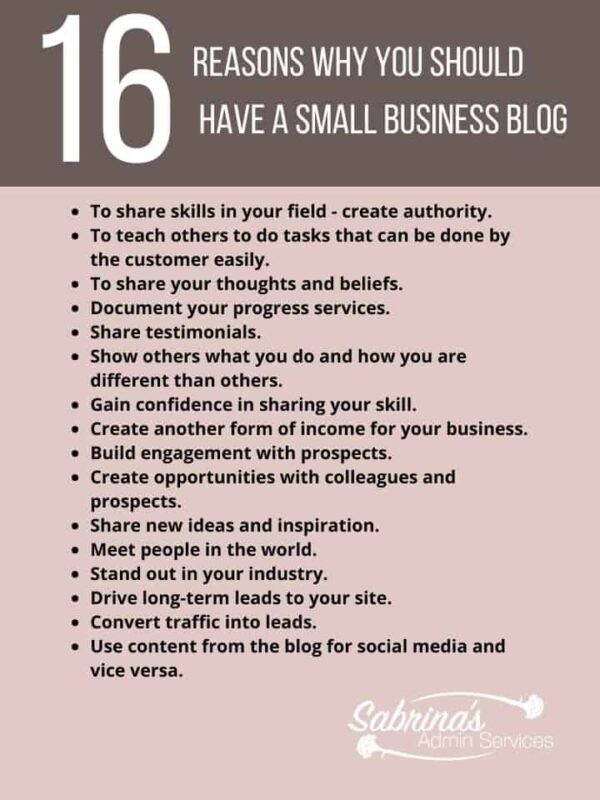
Should I have a business blog? 16 Reasons to Start a Small Business Blog Today
- To share skills in your field – create authority.
- Teach others tasks the customer can easily do.
- To share your thoughts and beliefs.
- Document your progress in services.
- Share testimonials of your services.
- Show others what you do and how you are different than others.
- Gain confidence in sharing your skills.
- Create another income stream for your business.
- Build engagement with prospects.
- Create opportunities with colleagues (affiliate) and prospects.
- Share new ideas and inspiration.
- Meet people in the world.
- Stand out in your industry.
- Drive long-term leads to your site.
- Convert traffic into leads.
- Use blog content for social media, and vice versa.
There are many more benefits of having your own small business blog. These are just a few of the main reasons to own your own website. Now let’s talk about how to get you started with your small business blog.
Why a Blog Matters Even More in 2026
A blog matters more in 2026 because search has changed. People now get answers from AI summaries as well as the traditional blue links in search. Those summaries are built from helpful pages like the ones on your website.
Here is what the latest numbers say:
- A blog is a top return-on-investment channel. In HubSpot’s 2026 State of Marketing data, 27% of marketers named their website, blog, and SEO (affiliate) as their number one ROI channel, and small businesses were 23% more likely than average to see ROI from blog posts (Source: Superblog’s 2026 roundup of HubSpot data).
- AI Overviews are changing clicks. Ahrefs found a 58% lower click-through rate for the top organic result when an AI Overview appears. Being the source the AI quotes is the new goal, and that requires having a page worth quoting.
- AI tools favor the top of your page. An analysis reported by Search Engine Land found 44.2% of ChatGPT citations came from the first 30% of a page. That’s why your posts should give the answer early.
- AI-referred traffic is growing. Semrush reported 66% growth in AI-referred traffic across 2025.
What does this mean for you as a small business owner? Your social media posts disappear from the feed within a day or two, and AI tools can’t easily cite them. A blog post on your own site keeps working, can be found by search engines and AI tools, and points people to your services.
Want help turning your blog into a lead source?
Between writing, scheduling, and updating your website, a blog can quietly become one more thing you never get to. My Recurring Services are built for businesses with employees who need dependable help each month, including social media marketing and website help and maintenance. Let’s talk about what to take off your plate.
How to Write Blog Posts That Readers and AI Tools Can Use
The simplest approach is to answer the reader’s question in the first one or two sentences, then explain. Here’s a checklist you can use for every post:
- Use question-style headings. “How much does X cost?” or “Should I do X?” match how people type and speak their searches.
- Answer first, explain second. Put a short, direct answer right under each heading, then add your detail, story, or example.
- Keep answers self-contained. A short paragraph that makes sense on its own is easier to quote than one that depends on the paragraphs around it.
- Show real experience. Client stories (with permission), your own process, and lessons learned are what generic AI content can’t copy.
- Add a short FAQ. Two to five real questions your clients (affiliate) ask, with short answers, like the FAQ at the end of this post.
- Link to your related posts and services. This helps readers keep going and helps search engines understand your site.
- Refresh older posts. Update stats, tools, and dates once or twice a year. It is often faster than writing from scratch, and it’s exactly why you’ll want a blog mid-year review. Be sure to pick the right time of year to update and reshare your blog post. Sometimes we share at the wrong time. When we reshare and refresh older posts, we can easily adjust this without adding too much time. Take a moment to search the topic and see when it is searched throughout the year.
- Add your name and a short bio. Readers and search engines trust content with a real person behind it.
Use AI to Help, Not to Replace Your Voice
Yes, you can use AI for your business blog, as a helper for outlines, first drafts, and cleanup, not as a replacement for your voice. Most bloggers use AI tools at least sometimes; Orbit Media’s 2025 survey put it at 95%. That means plain, generic AI text is everywhere, and your real experience is what stands out.
Some simple ground rules:
- Start with your own notes, story, or client question, then let AI help organize it.
- Fact-check every stat, price, and tool name before you publish.
- Reread the post out loud. If it doesn’t sound like you, rewrite it.
- Never publish client details or private information into an AI tool.
How Much Time Does a Business Blog Really Take?
Plan on roughly 2-4 hours per post at the start, and less as you build a routine. That includes planning, drafting, adding images, and publishing. For a busy owner of a 1-5 person business, a realistic goal is one solid post a month, or two if you can manage it.
A few ways to keep it manageable:
- Batch your work. Outline several posts at once, and write on a set block of time. Learn more about blocking your work.
- Repurpose everything. One post can become social captions, a Pinterest pin, and an email tip (see reason 16 above).
- Update instead of always starting new. Refreshing your best posts each year keeps them working for you.
- Delegate the parts you don’t enjoy. Scheduling, formatting, images, and social sharing are easy to hand off.
Need a hand with the follow-through? Get in touch about Recurring Admin Services, and we can talk about which blog and website tasks are worth handing off.
There are many more benefits of having your own small business blog. These are just some of the important reasons to own your own website. Now let’s talk about how to get you started with your small business blog.
How to Create a Business Blog?
Now that you have decided to start your very own business blog. Read this post and answer these questions. This will give you direction on where to start.
Decide on a Domain Name, hosting company, and theme to use.
Next, decide on a Domain Name (URL name). This is the name you want your business to be associated with online. It should begin with “HTTPS://”. You can check whether a domain name is available on any hosting site.
Now, find a Hosting Company. Check out places like HostGator and Bluehost for hosting.
Tips when picking your blog hosting company.
Each hosting company is different, so consider these tips while determining which one to buy.
- Switching hosting companies is difficult, so choose one that works for you and offers excellent customer service.
- Choose a hosting company that fits your budget and offers a well-monitored platform with daily backups.
- Your site’s speed matters. Search engines penalize slower sites.
- Transparency is essential. If you can not find answers to your questions, pass and move on to another hosting company.
- Read reviews of the web hosting companies you’re considering before deciding. This will give you a glimpse of what people like and dislike about a company.
Determine your theme (layout) for your business blog.
Now, determine the theme you want to use. Many hosting companies offer themes you can test and use for your business blog. Some are free, and some have additional fees because they are third-party themes. Be sure to pick a theme that works for your business services or products.
Pick a simple theme that gives you the pages you need for your services or products. For theme and layout ideas, look at larger companies in your industry. This will help give you perspective and see what is possible in the future. Keep in mind that your blog may grow so be flexible at the start because it may be difficult to change later if you have a limited theme.
Saving time when writing your business blog is essential; visit our post for time-saving tips. You can also create your checklist to help you remember all the tasks you need to do.
About six months after you started blogging, it is time to do a blog mid-year review. Read our post here for help.
Read More about Business Blog for Service Websites: How to Layout Your Small Business Services Website
Business Blog FAQs
Yes. A blog is one of the few marketing assets you own, and search engines and AI tools use helpful web pages to answer questions. Social media posts fade quickly, while a good blog post can bring in visitors and leads for months or years.
Once or twice a month is a realistic starting point for a small business. Consistency matters more than volume, so choose a schedule you can keep, and refresh your best older posts once or twice a year.
Long enough to fully answer the question, which is usually about 800 to 1,500 words for most small business topics. Put the direct answer near the top, then add detail and examples below.
Yes, as a helper. Use AI for outlines, first drafts, and edits, then add your own experience, fact-check everything, and make sure it sounds like you. Posts with real stories and expertise stand out more than generic AI text.
AI tools pull answers from clear, trustworthy pages. If your posts use question-based headings, answer early, and show your real experience, they are easier for those tools to understand and quote.
Your main costs are a domain name and web hosting, plus an optional paid theme. Prices vary and change often, so compare current plans and renewal rates directly on the host’s site before you buy.
Well, there you have it! I hope this post gives you a glimpse of why you need a blog for your business. If you need help with your website, check out our website help and maintenance service.
Please note that these are affiliate links through Amazon (affiliate). At no additional cost to you, I will earn an affiliate commission if you click through and decide to make a purchase.
Below are more related posts!









Leave a Reply