Whether you are an independent contractor or a small business owner, staying on top of your business with quarterly tasks will make year-end easier and income taxes less stressful. To do that, I recommend creating a Quarterly Small Business Financial Checklist. Since quarters 1, 2, and 3 are pretty much the same, you can create one checklist for all these quarters. Today, I will share the areas to add to this quarterly checklist. This post focuses on the financial tasks you need to complete to keep your business running smoothly throughout the year. It has been updated for 2026.
Key Takeaways
- Quarterly financial checklists for the first three quarters of the year reduce end-of-year stress and simplify income tax preparation for small business owners and independent contractors.
- Ideally, complete bank account and credit card reconciliations monthly, not quarterly, to quickly identify fraudulent transactions and keep financial records accurate.
- Quarter 4 requires a separate checklist that includes year-end tasks such as preparing IRS forms W-2 and 1099s, which are not part of the standard quarterly checklist.
- Regularly review Profit and Loss statements and Balance Sheets quarterly to understand business financial health and enable meaningful period-over-period comparisons.
- Customize quarterly checklists to include only the task categories relevant to each business, such as inventory management or payroll processing, depending on the business model.
Checklists to Make
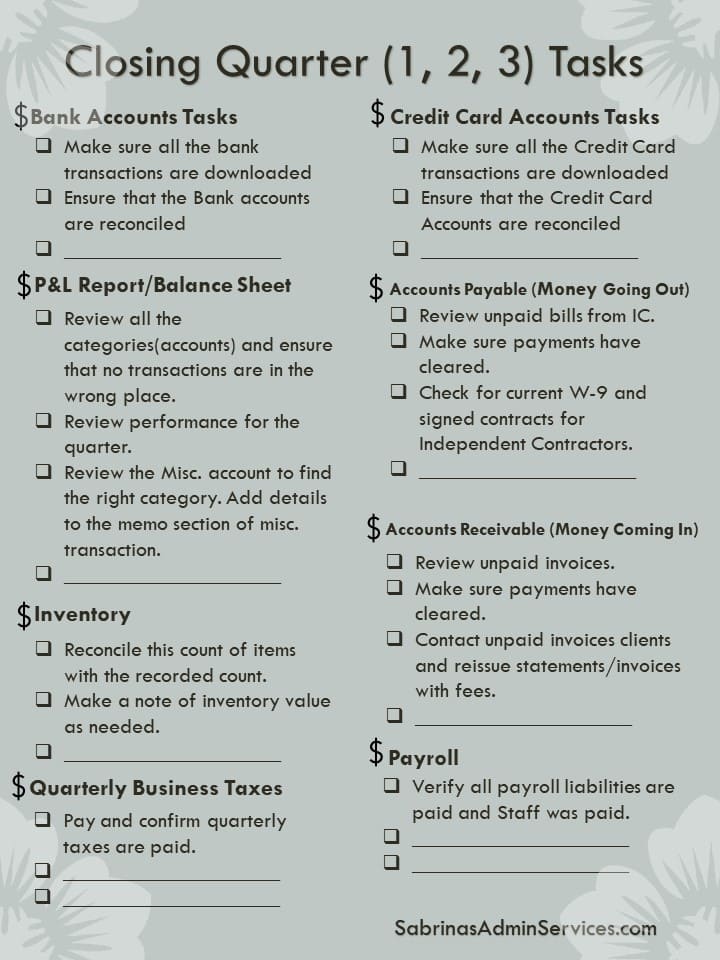
Keep in mind that this post will discuss eight different task groups. However, you may not use all of them, and your industry/state/country may have other groups. Please add or remove tasks that don’t apply to you or your business. Let’s begin.
Note: This checklist is NOT to be used for Quarter 4 because there are additional tasks to complete beyond those listed here. The Quarter 4 checklist should include end-of-year and new-year tasks, such as IRS forms W-2 and 1099s.
Bank Accounts Tasks
First, let’s discuss bank account tasks. Your business probably has a checking and a savings account. Reconcile both accounts. Reconciling them with your bank will help you stay on top of fraudulent transactions and account issues. Complete these bank statement reconciliations at the beginning of every month, but if your business is small, you can do them quarterly.
First, download all transactions from your bank into your money management software, like FreshBooks (affiliate), QuickBooks, or Quicken (affiliate). When you set the date range, make sure you select the correct range for that quarter.
- Quarter 1 is from January 1 to March 31st.
- Quarter 2 is from April 1 to June 30th.
- Quarter 3 is from July 1 to September 30th.
Most financial advice treats monthly reconciliation as set in stone, but many small business owners miss a strategic middle ground. The optimal reconciliation frequency isn’t one-size-fits-all; it depends on your transaction volume and business complexity.
Transaction Frequency Assessment Framework:
I broke this down into risk factors. The bottom line: the higher the risk, the more often you need to reconcile.
Weekly Reconciliation Zone (High Risk)
- 50+ transactions per week
- Multiple payment processors
- High-value individual transactions ($5,000+)
- Cash-heavy business model
Bi-Weekly Sweet Spot (Optimal for Most)
- 20-50 transactions per week
- 2-3 payment methods
- Moderate transaction values ($500-$5,000)
- Primarily digital payments
Monthly Standard (Traditional Approach)
- 10-20 transactions per week
- Single primary payment method
- Lower transaction values (under $500)
- Predictable income patterns
The Hidden Cost Calculator:
A 15-minute bi-weekly reconciliation saves 4.5 hours quarterly compared to letting transactions pile up. That’s $450-$900 in saved bookkeeping costs at standard rates, plus early fraud detection that averages 23 days faster than quarterly reviews. Check out our post about a 15-minute weekly money date with your business.
Quarterly Reconciliation Time investment by business size.
You may be wondering how long it will take to reconcile your business. I created this chart to help you figure out how much time you need to set aside to get it done each month. It’s not as much time as you may think. This table shows monthly transactions and how long it will take to reconcile the account.
| Business Type | Monthly Transactions | Reconciliation Time |
| Solopreneur/Freelancer | 10-30 | 30-45 minutes |
| Small Service Business | 31-75 | 1-2 hours |
| Product-Based Business | 76-150 | 2-3 hours |
| Growing Small Business | 150+ | 3-5 hours |
Credit Card Account Tasks
The next section of tasks is to download your credit card transactions and reconcile your account. Some credit cards may create errors when downloading, so take your time. If you can’t trust your downloads, try entering the data manually, then download and link the correct transactions to your existing register entries. This way, you can spot duplicate transactions.
Case Study:
Catching a $3,200 Fraudulent Subscription Before It Multiplied
Marcus, a freelance graphic designer, reconciled his business credit card only at year-end for his first two years in business.
During his first quarterly reconciliation in Q1 of year three, he found a $47 monthly charge for a design software service he’d canceled eight months earlier. The company kept billing him because it didn’t process his cancellation request correctly.
By catching it during a quarterly review rather than an annual one, Marcus recovered $376 immediately and prevented an additional $564 in charges through year-end. More critically, he discovered two other subscriptions he no longer used, totaling $83 monthly.
This single quarterly review session saved him $1,372 annually and taught him to review recurring charges every 90 days, which uncovered $3,200 in unnecessary subscription expenses over the next two years.
To quickly identify and eliminate fraudulent transactions, reconcile every month instead of waiting for each quarter. The longer you wait, the more likely you are to forget transaction details. No one can remember everything in their small business.
Manage your financial life and achieve more. Try Quicken for 30 days with our money-back guarantee. Products To Help You Manage Your Money:
Quicken Simplifi - Great for personal tracking
Quicken Business & Personal - perfect for mobile users strictly
Classic Quicken for Windows and Mac - Ideal for laptop users and convenient for viewing on the go.


Profit and Loss Report/Balance Sheet
The P&L statement, also known as the Profit and Loss report, shows the Income and Expenses from your business over a given period of time. For this purpose, you will look at these reports over a three-month period and compare them to the prior three-month period or prior year.
The Balance Sheet is usually for your accountant. It is a statement of a business’s assets, liabilities, and owner’s equity as of any given date. Typically, a balance sheet is prepared at the end of set periods (e.g., every quarter or annually). It is good to view this statement (definition from Small Business Administration); however, you probably will not do anything with it. If you have questions, ask your accountant for help.
Each bookkeeping software program places these reports a little differently. Usually, you can find these reports in the Reports section of the main menu.
Other reports, like a Cash Flow Statement and Cost of Goods Sold Report, may be needed depending on your industry. If you want to review other reports, you can add them to this section.
Critical P&L Metrics to Track Quarter-Over-Quarter
If you see these metrics fall in the healthy range, you are good. But if they fall in the red-flag range, you will need to take action. Keep in mind that you may have some slow periods like summer or winter months. Comparing this information to the prior-year period helps you determine whether there is a downward or upward trend.
| Metric | Healthy Range | Red Flag Indicator |
| Gross Profit Margin | 60-80% for services | Declining 10%+ in one quarter |
| Operating Expense Ratio | 20-40% of revenue | Exceeding 50% consistently |
| Net Profit Margin | 10-20% minimum | Below 5% for two quarters |
| Revenue Growth Rate | 5-15% quarter-over-quarter | Negative growth two quarters |
Is it mid-year? Ready to do your Small Business Mid-Year Review? Check out this post for help with Small Business Bookkeeping Mid Year Review Tips.
Quarterly Business Taxes Tasks
The next section to add to your Quarterly Small Business Financial Checklist is quarterly business taxes. Whether you are a sole proprietor or have a business, you may want/need to pay quarterly estimated taxes. A section on your checklist that details the type of estimated tax payment (Federal, State, or Local) and how to submit or mail the payment works well. You can also add the amount if it is a fixed number and login information to make it easy to pay when you need to.
Below is some information you may want to add to this section:
- Federal: Date submitted or mailed, amount owed, login information, and any notes needed to complete the transaction.
- State: Date submitted or mailed, the amount owed, login information needed, etc.
- Local: Income amount for the quarter, amount owed for this quarter, and login information needed.
Quarterly Estimated Tax Payment deadline per quarter.
Each quarter, all businesses must pay estimated taxes, even solopreneurs. Below are the payment due dates and income periods for the U.S.A.
| Quarter | Income Period | Payment Due Date |
| Q1 | Jan 1 – Mar 31 | April 15 |
| Q2 | Apr 1 – Jun 30 | June 15 |
| Q3 | Jul 1 – Sep 30 | September 15 |
| Q4 | Oct 1 – Dec 31 | January 15 (next year), but pay before the end of December so you can deduct it on your tax return |
Things to keep in mind.
Instead of treating quarterly reviews as historical record-keeping, use this information to help you build predictive intelligence that flags problems before they become crises. This will help if you don’t have anyone else with eyes on your numbers. This approach shifts from reactive accounting to proactive.
Create Your Variance Trigger System:
These systems help you know what to do next when alerts happen.
Revenue Variance Alerts
- Set threshold: 15% below the same quarter last year
- Action trigger: Review pricing strategy and client retention
- Early indicator: Declining average transaction size
Expense Creep Detection
- Set threshold: 10% increase in any category quarter-over-quarter
- Action trigger: Audit vendor contracts and subscription services
- Early indicator: Proportional relationship between revenue and variable costs breaking down
Cash Runway Calculator
- Formula: Current cash ÷ average monthly burn rate
- Danger zone: Less than 3 months runway
- Action trigger: Accelerate collections or secure credit line
Profitability Trajectory
- Compare gross profit margins across three consecutive quarters
- Declining trend of 5%+ signals pricing or cost structure issues
- Rising trend validates business model strength
How to set up the spreadsheet.
These systems help you know what to do next when alerts happen. Here’s an example of how to set this up in a spreadsheet:
Create four separate sheets in your workbook: one for each metric below.
In each sheet, set up three columns: Quarter, Actual Amount, and Variance %. Use conditional formatting to highlight cells red when they cross your threshold.
For the Cash Runway Calculator (affiliate), create a formula that divides your current cash balance by your average monthly expenses from the past three months.
If you don’t have anyone else with eyes on your numbers, this spreadsheet-based approach provides an automated second set of eyes on your financial health.
This dashboard takes 30 minutes to set up in any spreadsheet and turns your quarterly checklist from a compliance task into strategic intelligence that predicts cash crunches 60-90 days in advance.
Accounts Payable (Money Going Out) Tasks
The next section (business expenses) should include anything that involves money going out. This can also include quarterly bills. These bills may be ones you forget because it does not happen monthly, like the sewer or water bill.
Another task is to review unpaid vendor bills, make sure all unpaid IC bills are paid, confirm all payments have cleared, and check the files (digital or physical) to ensure you have the subcontractors’ current W-9 forms and signed contracts.
You can also file receipts in the appropriate area, physically or digitally.
Want to learn more? Accounts Payable Tips Every Owner Needs to Know
Vendor Payment Terms Strategy for Cash Flow Optimization
You can assign your own payment terms for your business. To make it easy to remember, stay consistent with all your clients (affiliate). Below are standard payment terms, whether they impact your cash flow, and when they work best.
| Payment Terms | Cash Flow Impact | Best Use Case |
| Net 15 | High pressure | Small recurring expenses |
| Net 30 | Standard management | Most vendor relationships |
| Net 45-60 | Optimal breathing room | Large project expenses |
| 2/10 Net 30 | 36% annual return | When cash is available early |
Accounts Receivable (Money Coming In) Tasks
The next section of tasks is to the incoming money. In this section, you can add tasks like reviewing unpaid invoices and sending out newly updated invoices with late fees. You can also make sure all payments clear on your bank statement.
Get more information at 9 Things Every Owner Needs To Know About Accounts Receivable.
Invoice Collection Timeline and Action Steps
I have touched on this before, but your invoice collection time frame can easily affect how successfully you receive payment when a client doesn’t pay. Check out my post: How to collect your money from a client that didn’t pay.
| Days Outstanding | Action Required | Success Rate |
| 0-15 days | Friendly reminder email | 85% collection |
| 16-30 days | Phone call follow-up | 70% collection |
| 31-60 days | Formal demand letter | 50% collection |
| 60+ days | Collections agency/legal | 30% collection |
Inventory Tasks (optional)
Complete this checklist section only if you have inventory in your business. Products you use to make something else or products you sell to customers should be in this section of tasks. Having an inventory tasks list will help you determine your inventory status and what you need to order or not order anymore.
You can also review inventory costs and see whether other supplies are more affordable for those products. This will give you a better idea of what your needed items cost and what items you overspent on.
Payroll Tasks(optional)
Lastly, review your payroll tasks section. This involves ensuring all your payroll liabilities are paid, and your staff is paid. It may also include making payments and submitting quarterly returns electronically.
Please note: Each business has its own payroll tax requirements. Be sure you know your situation before making this checklist section.
You can also use this section to review employee paperwork and ensure you have all required documents. Visit my How to Organize Employee Records post for more details. Verify things like Social Security numbers for new employees.
Don’t want to make one yourself? I have a white-background version you can get for free, plus all my other small-business checklists. Fill out this form to get not only this checklist, but also all my other small business checklists to help your business stay productive and on track!
Quarterly Small Business Financial Checklist (1,2,3 only)
Get your free copy of the Quarterly Small Business Financial Checklist to remind you what needs to be done each quarter.
Mini Glossary
If you are wondering what these words mean and are new to owning your business, below are definitions of the terms I used above.
Reconciliation: The process of comparing your internal financial records against bank or credit card statements to ensure all transactions match and identify any discrepancies, errors, or fraudulent charges.
Profit and Loss Statement (P&L): A financial report that summarizes a business’s revenues, costs, and expenses over a specific period, showing whether the business made or lost money during that time frame.
Balance Sheet: A financial statement that provides a snapshot of a business’s assets, liabilities, and owner’s equity at a specific point in time, typically prepared at the end of a quarter or year.
Estimated Quarterly Taxes: Tax payments self-employed individuals and business owners make four times a year to cover income tax and self-employment tax on business earnings, required when you expect to owe $1,000 or more in taxes.
Accounts Payable: The money a business owes to vendors, suppliers, and service providers for goods or services received but not yet paid for, representing short-term financial obligations.
FAQs
Yes. Automated transaction imports can miss transactions, duplicate entries, incorrectly categorize expenses, or fail to catch fraudulent charges. Reconciliation is the verification step that confirms your software’s automated categorization matches reality.
Many business owners discover their “automated” systems have miscategorized transactions for months, creating inaccurate financial reports that lead to poor business decisions.
You need a separate Quarter 4 checklist because year-end requires additional tasks not included in the standard quarterly checklist.
Q4 tasks include preparing and filing W-2s for employees, issuing 1099-NEC forms to contractors paid $600 or more, reconciling all accounts for the full year, reviewing depreciation schedules, maximizing tax deductions before year-end, and planning for the upcoming year’s estimated taxes. Quarter 4 is essentially a quarterly review plus year-end closing activities.
A P&L statement shows your business performance over time (the quarter)—how much you earned, spent, and profited during those three months, making it useful for operational decisions and trend analysis.
A balance sheet shows your financial position at a single point in time: what you own, owe, and your equity stake on the last day of the quarter, making it useful for understanding overall financial health and net worth.
Most small business owners focus primarily on the P&L for quarterly management decisions, while the balance sheet becomes more important for loan applications, selling the business, or bringing in investors.
Conclusion
Well, that’s it for now. I hope this post helps you organize your quarter tasks and make them easier to manage during tax season. Please leave a comment below with any questions.
If you are looking for more money management and productivity posts, check out the posts below.