
Procrastination is the silent killer of small business leaders’ dreams. You know the feeling: that important project sits on your desk (affiliate) while you reorganize your email inbox for the third time this week. The marketing campaign stays unfinished while you dive deep into competitor research. The product launch gets pushed back another month because “it’s not quite ready yet.” I am going to share how creativity can overcome small business procrastination. Follow along and conquer your business procrastination once and for all.
Topics
Key Takeaways
- Procrastination threatens small business success, but creativity offers a solution.
- Traditional productivity advice often overlooks the psychological reasons for procrastination.
- Gamifying tasks and using visuals can make your workload more engaging.
- Applying creative constraints encourages quick decision-making and reduces perfectionism.
- Build a creative toolkit to identify solutions and strengthen your ability to overcome procrastination.
As a small business owner, procrastination isn’t just a personal productivity issue; it’s a significant threat to business survival. However, here’s what most entrepreneurs often overlook: creativity isn’t just about artistic expression or innovative products. It’s your secret weapon against procrastination.
Why Traditional Productivity Advice Falls Short
Most advice on overcoming procrastination focuses on discipline, time management, and willpower. While these strategies have their place, they often miss a crucial element: the psychological roots of why we procrastinate.
Procrastination typically stems from fear of failing, perfectionism, overwhelm, or simple boredom. When a task feels too big, too scary, or too mundane, our brains instinctively seek escape routes. This is where creativity becomes your ally, not your enemy.
Ways to use creativity to overcome small business procrastination
Creativity transforms procrastination by making tasks more engaging, breaking down mental barriers, and providing alternative pathways to completion. Here’s how to harness this power in your small business:
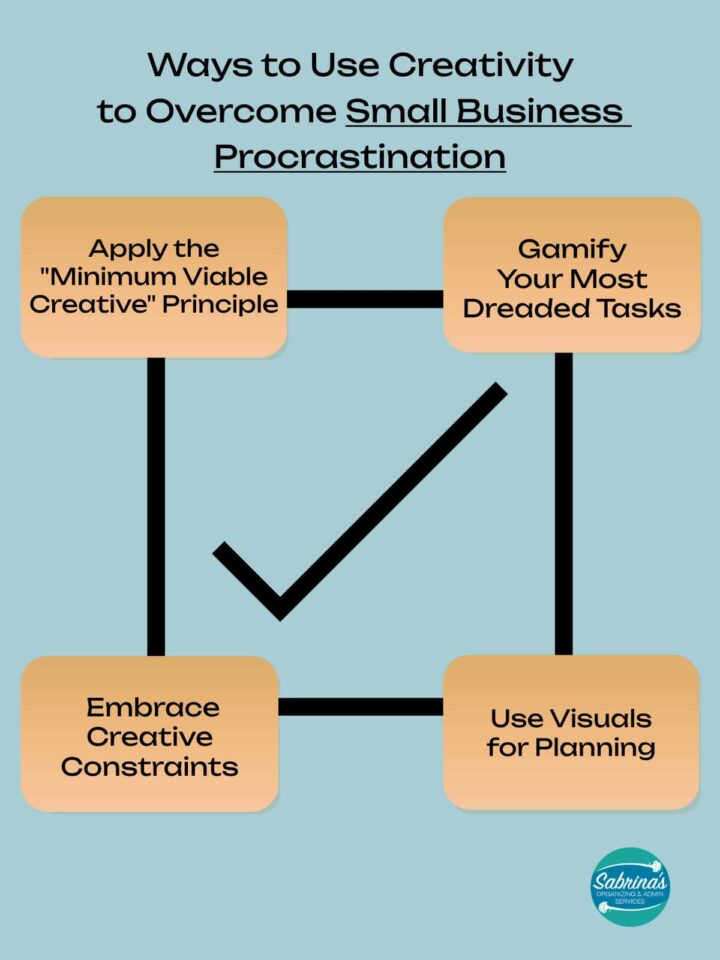
1. Gamify Your Most Dreaded Tasks
Turn tedious administrative work into a game. Create a system for completing invoices, reassess and review your steps to identify redundant tasks, or design reward milestones for completing certain in-depth parts of a project. One business owner I know tries to improve their administrative functions like a game, trying to beat her previous month’s processing time while maintaining accuracy.
2. Use Visuals for Planning
Instead of a traditional to-do list, create visual mind maps, flowcharts, or even comic strips that illustrate your business processes. You can even have a brainstorming session with your support team members to help hash out what needs to be done. When you can see the complete project from start to finish, it becomes more tangible to achieve. Visual planning also helps identify potential roadblocks before they become procrastination triggers. Procrastination triggers can be the downfall of any small business owner.
3. Apply the “Minimum Viable Creative” Principle
Minimum Viable Creative emphasizes experimentation, user feedback, and iterative design. The core idea is to maximize value from available talent and resources in the shortest time.
Perfectionism is procrastination’s best friend. Combat this by embracing creative experiments. I like to research and plan about 80% of a project, then take action. I know everything will not be perfect, and it will serve as a learning lesson for a better product in the future. Some other examples are:
Instead of waiting for the ideal marketing campaign, create three quick, imperfect versions and test them through A/B testing.
Rather than postponing your website launch until every detail is flawless, publish a “good enough” version and gather honest feedback from clients, family, and friends now to refine the site and gain a different perspective for an improved product.
4. Change Your Environment and Approach
Creativity thrives on novelty. When you’re stuck on a project, change your physical environment or the medium you’re working in. Write your business plan in a coffee (affiliate) shop or another part of your home, instead of your primary office. Record voice memos while walking instead of typing notes at your desk (affiliate). Sketch out your ideas using colored pens (affiliate) instead of relying on spreadsheets.
5. Embrace Creative Constraints
Paradoxically, limitations can boost creativity and reduce procrastination. Give yourself artificial constraints: write a marketing email in precisely 100 words, design a logo using only two colors, or complete a client proposal in 30 minutes. These constraints force quick decisions and prevent the endless tweaking that feeds procrastination. Be vigilant about your deadline, or this will not work. The longer you allow yourself to complete a task, the longer it will take. Shortening the timeline will shorten the project.
Examples of Creative Techniques That Help Overcome Business Tasks
Financial Planning: Turn your budget into a visual dashboard with charts, graphs, and color-coding. Create financial “scenarios” as stories—what happens to your cash flow if you land that big client or if expenses increase by 20%?
Content Creation: Use creative prompts to generate ideas quickly. “What would my product look like if it was _?” or “How would I explain this service to a 10-year-old?” can unlock fresh perspectives and overcome writer’s block.
Networking: Design creative introduction games for yourself. Challenge yourself to find an unexpected connection point with each person you meet or create themed conversation starters that make networking feel more like improvisation than interrogation.
Problem-Solving: When facing business challenges, try creative problem-solving techniques like “worst possible idea” brainstorming (which often leads to breakthrough insights) or role-playing how different types of businesses would handle your situation.
Make Your Creative Anti-Procrastination Toolkit
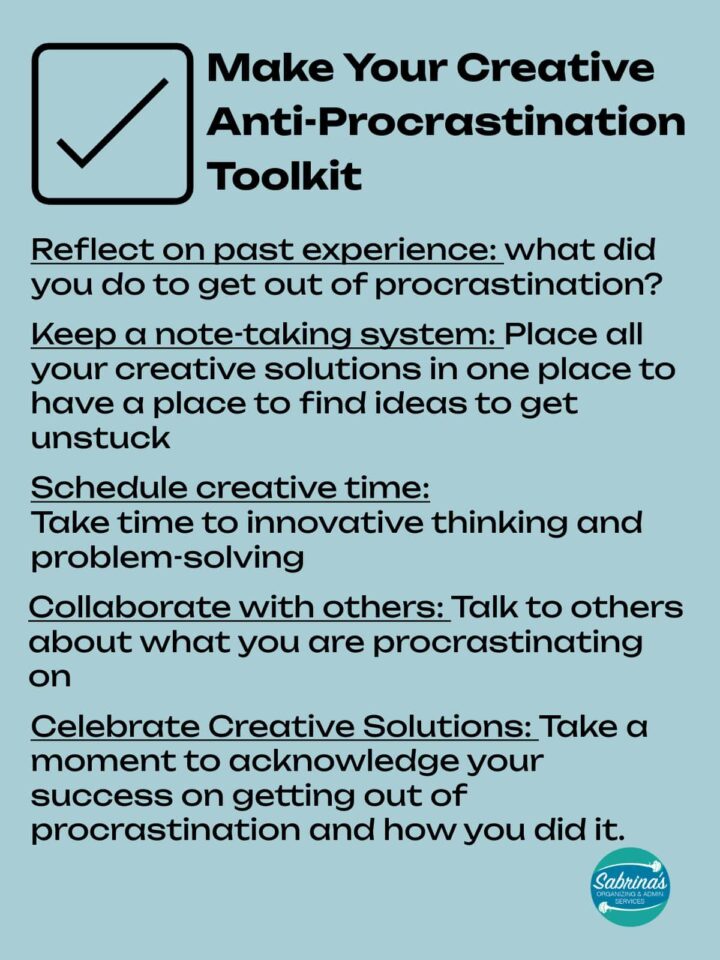
You may be thinking, ‘How can I harness my creativity and make it usable when I’m procrastinating?’ I’m glad you asked. Putting all your creative ideas in one place creates a one-stop shop for ideas, reducing procrastination in your business. Start building habits that make creativity overcome your small business procrastination:
Reflect on past experience: Take a moment and determine how you got yourself out of procrastinating on a project. Write what made you stop procrastinating and act. Be specific about the important tasks that pulled you out of procrastination and how you felt before, during, and after you were able to move forward.
Keep a note-taking system: Whether it’s a notebook, phone app, or voice recorder, have a way to capture creative solutions when they strike quickly. This prevents good ideas from being lost and gives you a resource when you’re feeling stuck.
Schedule creative time: Block out time specifically for innovative thinking and problem-solving. This isn’t “wasted time”—it’s an investment in your business’s agility and your productivity.
Collaborate with others: Sometimes the best way to overcome procrastination is to involve other people. Partner with different business owners for accountability, bounce ideas off trusted advisors, or even explain your stuck project to a friend who knows nothing about your industry. Create your support team to help you overcome procrastination.
Celebrate creative solutions: When you successfully use creativity to overcome procrastination, take a moment to acknowledge it. This reinforces the neural pathways that link creativity to success in problem-solving.
The Long-Term Benefits
When you consistently apply creative approaches to procrastination, something remarkable happens: your business becomes more adaptable, innovative, and resilient. You develop a reputation for getting things done, but more importantly, you build confidence in your ability to handle whatever challenges come your way.
Creative problem-solving skills transfer across all areas of your business. The same mindset that helps you overcome procrastination on mundane tasks will help you innovate your way out of market challenges, operational bottlenecks, and growth plateaus.
Start Where You Are
You don’t need to be an artist or a naturally creative person to use these techniques. Creativity is a skill that develops with practice, and every small business owner already has creative moments—you might not recognize them.
The next time you catch yourself procrastinating, pause and ask: “How can I make this more interesting, engaging, or fun?” The answer might be more straightforward than you think, and the results could transform not just your productivity but your entire approach to running your business.
Remember, the goal isn’t to eliminate all procrastination; it’s to use creativity to overcome small-business procrastination. It’s to develop tools that help you move forward when you’re stuck. Creativity isn’t just about making things beautiful; it’s about making things possible.
Need help with your business productivity? Explore my virtual consultation services, where I can help you be accountable for your business’s tasks. Let’s tackle your struggles and find solutions.
Below are some additional posts that may also inspire you to think more creatively about your business model.
The Importance of Creativity in Business: A Skill for the Future.
Creative Procrastination: How to Stop Putting It Off & Create Awesome S***
Creativity and procrastination
Feel Free to visit my other posts for more productivity inspiration.






I love your ideas, Sabrina. In particular that there are different and creative ways to overcome procrastination and that it’s ok to start before you have a complete plan. I also like your small graphics.
I use the minimum viable creative principle, although I didn’t know that was the name for it, when I get stuck and start to procrastinate. I also belong to a couple of networking groups that have part of the meeting brainstorming to help a member with a business problem. Practicing brainstorming on your projects or on another person’s project helps to develop the skill and make you think outside the box, think creatively.
I love that you focused on what too few people do, that procrastination comes from deep within, from a feeling of discomfort (fear, anxiety, maybe boredom) and a desire to do anything to forestall or crush that feeling. I’m so intrigued by your approach to use creativity to combat it!
#5, giving yourself constraints, is probably the one I’d complain the most about and yet would yield the most success for me. That forced stricture, to be creative with one hand (or set of syllables) tied behind your back is hard to inflict upon yourself, but when you do, it’s where the magic is made. This post is so motivating!
I appreciate your perspective on integrating creativity as a means to overcome procrastination. The gamification and visual aspects are things several of my clients respond to. Not only does it make it fun, but it also plays to their natural creative strengths. It’s always beneficial when you set up systems that build on your strengths.
In general, I don’t tend to procrastinate. However, I do enjoy infusing creativity into whatever I’m doing. That makes the process more enjoyable for me.